Cognition,
Communication, and Co-operation in Living Systems. Biosemiosis in the Context of Self-organisation
Wolfgang Hofkirchner1,2, Günther Ellersdorfer2
1ICT&S
Center University of Salzburg
Sigmund-Haffner-Gasse 18, 5020 Salzburg,
Austria 2Unified Theory of Information Research Group c/o Institute
of Design and Technology Assessment Vienna University of Technology
Favoritenstraße 9, 1040 Vienna,
Austria wolfgang.hofkirchner@sbg.ac.at
Abstract:
In the
perspective of an as yet-to-be-developed Unified Theory of Information as part
of an as yet-to-be-developed theory of evolutionary systems
semiosis plausibly coincides
with self-organisation.
A concept of sign processes
that is flexible enough to perform two functions as follows is everything that
is required for this framework. It must relate to the most various manifestations of sign processes, thus enabling a variety of scientific
disciplines to use a common concept where it seems appropriate; at the same
time, it must be precise enough to fit the unique requirements of any individual branch of science
dealing with a
concrete manifestation. Different types of sign processes
have to be related
to, if not derived from (albeit in a nonformal way), different types of self-organisation.
The
paper illustrates how the relationship between the genus proximum of semiosis in
self-organising systems and the differentia
specifica of semiosis
in biota may be approached.
Keywords: Autopoiesis, functions, subject-object-dialectic
1. Introduction
Starting point of our deliberations is a bundle
of basic assumptions specified
in the following list:
The concept of information
(generation) as defined in terms of self-organising systems by the Unified
Theory of Information (e.g. Ellersdorfer and Hofkirchner 1994, Fenzl et al.
1998, Hofkirchner and Stockinger 2003) and the concept of sign (generation) as
defined in Peirceian triadic semiotics can be made co-extensive. A sign in the
wider sense of the term may be defined as a relation between a sign in the
narrower sense of the term and an object that is relative to somebody or
something that by producing this relation creates meaning. This formulation of
sign processes can easily be reinterpreted in terms of self-organising systems.
The somebody or something equals a self-organising system, the object equals a perturbation of the self-organising
system, and the sign in the narrow sense equals the order the self-organising
system is building up in respondence to the perturbation. Then information is
the relation between the self-organised order and the perturbation and this
relation is produced by the self-organising system and hence is relative to it
and meaningful to it. Semiosis as sign process is tantamount to information as
a process.
Semiotics deals with sign processes
or information processes. The units of semiosis or information processes are
self-organising systems. The units of biosemiosis are living systems.
Living systems represent a special
type of self-organising systems. They are characterised by a special quality
that makes them distinct from other forms of self-organising systems.
Living systems manifest subjectivity.
But it is not this feature that makes them distinct from other self-organising
systems. Each self-organising system manifests subjectivity albeit to an extent that depends on the stage of evolution the system is
located in. The minimal unit of subjectivity is a something that is provided
with a minimal quantum of degrees of freedom to act. This something is the most
rudimentary and most primitive subject.
2.
Subjects and Objects
Speaking of subjectivity means returning to the terms
subject and object.
According to our point of view,
the difference between subject and object may be seen in that a subject is
capable of determining itself while an object is not. An object is something
that is determined by something that is not itself. Being a subject supersedes
being merely an object. While an object has no possibility of acting in ways
different from merely reacting to external determinants, a subject is capable
of responding in its own, unequivocal way, that is, it can make use of degrees
of freedom, of freedom of choice, of choice between options all of which it
disposes of and thus makes the internal determine.
2.1.
The Dialectic between
Subject and Object
and the Nature
of Information
Subjects and objects are related. The
concepts are correlative. This has to be clarified in order to understand the
nature of information or semiosis. This, in turn, can only be achieved by a
proper understanding of how a subject joins up with an object. We envisage the
dialectic between subject and object in the following way:
On the one hand, there is something
that makes another subject to it. What effects the subjection is the subject.
What is being subjected is the object. On the other hand, the object objects to
its subjection and the subject is confronted by an objection. The fundamental
relationship of subject and object is the constant conflict between these two
opposing tendencies.
The dialectical nature of this relationship is revealed by the following:
·
firstly,
the sides are opposed to each other, that is, the subject is the opposite of
the object and vice versa;
·
secondly, they presuppose each other, that is, without a subject there is no object
and vice versa;
·
thirdly,
they are asymmetrical, that is, subject and object play different roles when
opposing each other (the subject
subjects, the object objects).
As a dialectical relationship it
tends toward spiralling up. Spiralling up occurs when the subject, impressed by
the objection, sets out to subject the object in a different way. Then subject
S evolves into a modified, restructured subject that disposes of a form F,
which represents another quality.
Now, if subject S does so, – if it
develops form F in respect to its object O, which objects in a certain way to being subjected in a certain way, –
then we can say that the object O gives rise to a new form F of the subject S
or the subject itself gives rise to a new form of itself with regards to the
object. We can say the object “in-forms” the subject or the subject “in-forms”
itself on behalf of the object – to “in-form” in the sense of to give rise to a
new form. The result of this process may be called “in-formation”, which is the
new form F related to object O by the activity of S or the relation of F to O
by S – S (F, O) – while keeping in mind that this relation is relative to S and
cannot be reduced to a dyadic relation of F and O. It is a kind of
meta-relation, or a triad.
Thus, information is generated by subjects in relation to objects.
Each change on the side of
the subject in
subject-object-relationships is tantamount to the generation of information.
This makes clear why information is
both subjective and objective. It refers both to a subject and an object
because it is the subject that is being informed and the object about which
information is simultaneously.
Information, finally, does not exist
outside of subject-object-relationships, because the informing process needs subjects to be informed and
objects to be informed about.
2.2.
The Rise of Subjectivity and Information Generacy
The making of something subject to
oneself which makes oneself a subject undergoes a process of unfolding so as to
let us distinguish between different types of subjects according to the degree
of subjectivity they manifest (Hofkirchner et al. forthcoming).
The minimal unit of subjectivity is a
something that is provided with a minimal quantum of degrees of freedom to act.
This something is the most rudimentary and most primitive subject. It differs fundamentally from being an object, that
is, something that does not dispose of any option to act.
An object which has no option
available strictly acts according to the Aristotelian causa efficiens and
causa materialis, while a subject’s act does include causa finalis and
causa formalis as well, for there is some end toward which the subject
directs its action and there is some form which the subject
implements through acting. End and form are options
at the disposal of the subject.
They are selected
0ut of a plural of options which make up the degrees of
freedom.
According to different types of
subjects there are different types of information generated by the subjects.
The more degrees of freedom, the more sophisticated the information generation
is. To draw a distinction is to create information. To choose an option is to
draw a distinction. The more options there are, the higher-developed the
creation of information is.
2.3.
Intrasubjective, Intersubjective and Supra-Subjective Information Generation
There are different
cases of the relationship between
a subject and its object
corresponding to the nature of the object:
·
the object
may be a simple one,
·
it may be a co-subject,
·
it may be a super-subject.
A simple object is an object which is
no subject at all or it is a subject of a simpler kind than that of the subject
in question; a co-subject is a subject of the same kind; and a super-subject is
a subject of a more complex kind (usually one composed of co-subjects).
In the first case, the opposing tendencies are
subjection and objection tending toward spiralling up in a three-step process:
·
the subject
acts on the object (subjection),
·
the object
reacts (objection),
·
the subject
changes its action by taking into account
the reaction of the object to its past action (new subjection).
Regarding information or sign
generation, these steps involve assimiliation – non-affordance – accommodation
(assimilation and accommodation being terms introduced by J. Piaget (1976,
1980) and affordance a term coined by J. J.
Gibson (1950, 1966, 1979)). Assimilation is the informational or semiosic aspect of
subjection. Affordance means the degree to which the object affords being
subjected, non-affordance the degree to which it does not. Finally,
accommodation is what happens informationally or semiosically if the subject
adapts to the object. Accommodation takes precedence over the next round of
trying to subject the object. Thus intrasubjective information, that is, information
in a cognitive sense is created.
In the second case, not only cognition is involved. A
number of (at least two) (co-)subjects interact. The opposing tendencies can be
called countering intersubjectification processes showing the following steps:
·
subject A acts on a subject
B (intersubjectification by A),
·
subject B reacts (intersubjectification by B),
·
and
subject A changes its action by taking into account the reaction of subject B
to its past action (new intersubjectification by A).
In informational or semiotic terms,
in both subject A and subject B information generation and sign production is
involved. Subject A bases its interaction with the other subject upon its being
informed by this very subject, and so
does subject B. That is, subject A starts the process with a given information.
It reaches out to subject B. And subject B informs itself about subject A’s
reaching out. This process can then be continued by subject B. Thus the
intersubjective information generation involves internal information generation
with each of the sides. This ties up with the information–message–understanding
distinction introduced by N. Luhmann (e.g. 2001). Information in a
communicative sense is created.
In the third case, not only
communication takes place. A quorum number of subjects co-act and the
outcome of this very co-action is a super-subject which, in turn, constrains
and enables the subjects. The opposing tendencies may be called objectification
and subjectification. The three steps of the spiralling-up process are as
follows:
·
subjects A and B and C... act conjointly on a super-subject (objectification),
·
the super-subject reacts (subjectification),
·
subject
A or subject B or subject C... changes its contribution to the joint action by
taking into account the reaction of the super-subject to the past action of A
or B or C... (new objectification).
In the perspective of information
generation and sign production, by communicating with each other subjects
produce supra-subjective information which informs them, in turn. This is in
line with the Luhmannian categories of variation–selection–stabilisation
(ibd.). Information in a co-operative sense is created.
3. Living Systems
It is important
to notice that evolving, that is, self-organising systems play the part of subjects and objects as well.
This
new outlook provides
a framework within
which the coincidence of self-organisation and information is plausible. Information is then every process (and every outcome
of a process) where the system changes its behaviour, its state, or
its structure due to some given conditions (Fenzl et al. 1996). Insofar as in
each self-organising process the activity that is performed by the system in
its own way is nevertheless triggered by something that is not the system
itself, each self-organising process establishes informational relations, i.e.,
relations between the triggers, the system itself, and its activities
(including the products of these activities).
What
we get here is the equation self-organisation = information. Where we started
from is the equation sign =
information. Thus, the overall result is the equation sign = self-organisation.
Different manifestations of sign processes, then, will have to be linked to different
manifestations of self-organising systems.
3.1.
Living Systems’ Information Generacy
To look for a general theory of
evolutionary systems means to stress that being a self-organising system is the genus proximum of the
whole bundle of different self-organising systems while acknowledging that
there have to be markers that demarcate the differentiae specificae of
ever more complex self-organising systems.
On the basis of the well-known
differentiation between the physical-chemical, the biotic and the social
(human, cultural) realms,
and on the basis of the many findings that imply that in these realms there do
exist self-organising processes, we have to devise a
theory that logically includes the type of self-organisation that is found at a later stage of evolution
as instance of a universal
that is made up of just that type and the preceding type, namely,
social self-organisation as a concretisation of biotic self-organisation (which
has two parts: social biotic self-organisation and simple, nonsocial biotic
self-organisation) and the biotic one as concretisation of the
physical-chemical one (which again has two parts: biotic physical-chemical
self-organisation and simple, nonbiotic physical-chemical self-organisation).
Living systems share with non-living
self-organising ones the physical-chemical aspect of self-organisation: the
dissipation of energy of higher entropy than that of the imported energy.
Living systems transform nutrients,
obtained from the environment in most cases to ATP (adenosine triphosphate),
the basic universal currency of free energy (∆G°’= the standard free energy at
pH 7) in all living systems. This free energy is needed e.g. in the performance
of mechanical work in muscle contractions and other cellular movements, the
active transport of molecules and ions, and the synthesis of macromolecules and other biomolecules
from simple precursors (Stryer 1988). The free energy used in these processes,
which maintain an organism in a state that is far from equilibrium, is derived
from the environment in that way, that phototrophic organisms obtain it
by trapping light energy and chemotrophic organisms obtain this energy
by the break-down of foodstuffs. Before this free energy can be used it is
transformed into a special form, to be used for motion, active transport and
biosynthesis. In most processes, this special carrier of free energy is the molecule
adenosine tri-phosphate (ATP).
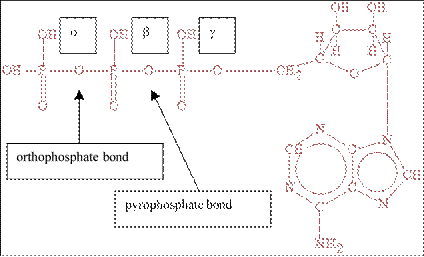
Energy is stored in the covalent
bonds between phosphates, with the greatest amount of energy (approximately
7 kcal/mole) in the bond between the second and third phosphate groups. This
covalent bond is known as a pyrophosphate bond. This amount of energy is
released, when the covalent bond is cleaved.
Figure 1: The chemical structure of the most important energy
providing molecule in living systems:
the adenosine tri-phosphate (ATP)
In ATP the energy is stored in the covalent
bonds between phosphates, where the greatest amount of energy is
captured in the covalent bond between the b
and g phosphate group, which is known as the pyrophosphate bond. An energy
amount of approximately -7kcal/mol is released, when this covalent bond is
cleaved and gets freely available as fuel molecule for metabolic activities
within the cell.
Thus free energy is liberated when
ATP is hydrolyzed to adenosine di-phosphate (ADP) and orthophosphate (Pi)
[1] or when ATP is hydrolyzed to adenosine mono-phosphate (AMP) and
pyrophosphate (PPi) [2]. The chemical reaction for the hydrolytic
break down and vice versa formation of ATP from ADP and orthophosphate is a
bi-directional chemical reaction and can be written as:
[1]
ATP + H2O ↔ ADP + Pi + H+ ∆G°’= -7,3 kcal/mol
[2]
ATP + H2O ↔ AMP + PPi + H+ ∆G°’= -7,3 kcal/mol
The free energy ∆G°’ liberated in the
hydrolysis of ATP is harnessed to drive reactions that require an input of free
energy as described above.
ATP, AMP and ADP are
inter-convertible by the action of a specific enzyme (adenylate kinase), and the reaction [3] can be written as:
[3]
ATP + AMP ↔ ADP + ADP
A third conformational variant of the
molecule ATP (besides ADP and AMP) is the cyclic form of its mono-phosphate
cAMP, which can also be converted by the specific action of an enzyme
(adenylate cyclase), and the reaction [4] can be written as:
[4]
ATP → cyclic AMP + PPi
ATP molecules are general energy
molecules involved in all major metabolic circuits within any type of cells. As
an example it should be mentioned that from one molecule of glucose, which is
transformed into free available energy in the Krebs-Cycle, 2 molecules of ATP
are generated. This ATP is the basic energy supplier in any anabolic process in
the cell such as biosynthesis of proteins and enzymes as well as structural
components to establish the cells integrity. In higher organisms we also see
ATP as an important component in the
transmission of neuronal signal e.g.: in the vertebrate neuronal system, also as one of the four nucleotides (ATP, GTP,
CTP, TTP) it is a component of the genetic information polymers, the constituents of DNA and RNA. Also the cyclic
form of adenosine
mono-phosphate (cAMP) is involved in a variety of biochemical
reactions within the cell, which acts as a controlling molecule in many
biological processes, where a signal coming to the surface of the cell is
mediated by cAMP towards inside the cell, a so called second messenger.
Finally, as we will discuss later cAMP acts as a signalling molecule between
different individual cells
e.g. in the slime mould Dictyostelium discoideum, or the fruiting myxobacterium Stigmatella
aurantiaca.
So we can summarize that this
phosphorylated adenosine in its different inter-convertible forms as shown
above acts as powerful and ubiquitous agent in different functions and on
different level of complexity in living systems:
1.
As energetic
agent:
A)
The energy
currency at different levels of the metabolism and specially the anabolism
2.
As informational agent:
A)
As structural component within the polymeres of the genetic
information, the DNA and the RNA
B) As
second messenger mediating
external information within the cellular context of a living system (cognition)
C) As
neurotransmitter in synaptic
gaps, thus routing
neuronal events within
an organismic context (communication)
D) As signalling molecule between
individual cells of the same species, as response to environmental changes and
trigger of concerted activities (co-operation)
In comparison to more basic systems
e.g.: the Benárd cell, where a steady flow of energy in form of heat enables
the formation of the typical
“cells” we postulate the steady flow of ATP in the living cell as the basic activity for self-organisation
activity in the living cell. The self generation of this basic energy currency
contributes to the break-down and build-up within
all other metabolic activities in the cell. The
main difference to the mere physical system as mentioned
in the Benárd cell system to the living cell system is, that the maintenance of
the energy flow is an intrinsic function of the living cell by itself,
contributing to the autopoietic property of the living cell, in the sense, as
mentioned by Humberto Maturana and
Francisco Varela in their theoretical concept (1992).
|
Type of energy
|
Source
|
System
|
Mechanism
|
|
Caloric energy (heat)
|
Extrinsic
|
Benárd
Cell
|
Dissipation
|
|
Chemical energy (catalysis)
|
Extrinsic
|
Belousov-Zhabotinski
Cell
|
Dissipation
|
|
Metabolic energy (ATP)
|
Intrinsic
|
Living Cell
|
Autopoiesis
|
Table 1: Comparison of different self-organising systems in respect
of their energy source
By converting all energy into this
ATP-molecule the cell can use it for diverse metabolic activities. This
condition enables the cell to do self-organising processes on a more complex
level which results in the concerted action of diverse intracellular cycles.
Thus by establishing such structurally based cycles also functionally new
qualities emerge within the cell.
The intracellular generation of ATP
is a process typical for all living systems and serves as the basic energy
currency, which is the driving force
for all metabolic activities
inside the cell. From our point of
view ATP is the agent who mediates the establishment of the conditions
necessary for the continuous throughput of energy, which is constituent for all
open dynamic systems, here in this context of living, autopoietic systems. The
ability to generate and appropriate this intrinsic energy source gave rise to
living systems.
Assuming a defined quality of energy
available within a living system it should be possible to set the boundary
conditions to trigger self-organized processes within the living system without
destroying the system identity, but contribute to a more advanced engineering
of new properties of the system. Intrinsic generated ATP fulfills such
prerequisites and can thus be designated as an autopoietic source of “high
quality energy” that maintains the self-organisation of the living system.
Taking these features of ATP into account we can look at this molecule as a
free available and auto-generated driving force of self-organising processes in
the living cellular and organismic system.
In analogy to the constant input of
thermic energy necessary for the emergence of Benárd cells (dissipative
self-organising systems in the physical realm) ATP-energy is also constant
available in autopoietic self-organising systems that belong to the biological
realm, that enables a multiplicity of emergent phenomena, which contribute to
the organismic (process-based) status of a living cell.
So we can say that the differentia
specifica of living systems in respect to their genus proximum, the
physical-chemical systems, is based on the ability to exploit this “high
quality energy” component as provided by ATP and its inter-convertible variants
ADP, AMP and cAMP.
All emergent phenomena depend on a
continuous energy-flow through the open system. As shown by Prigogine (e.g.
1980) is the dissipation of free energy within an open dynamic system the
driving force of self-organisation in physical and chemical systems. To assume
that this force is also driving self-organisation in living systems is only
half the truth. For sure there are such processes in the living system (e.g.:
Ca2+-cascades in nerve-impulse transmission, heart beat maintenance,
micelle formation, self-assembly of virus capsides etc.), but the majority of
processes constituting the functionality of a living cell depend on the “high
quality energy” of the auto-generated ATP.
Looking at autopoietic systems as
basically ATP-driven should enable the design of experimental set-ups with the
aim to detect the cellular ATP level with respect to complex reaction pathways
and hypercycles. On the other hand should the controlled manipulation of
intracellular ATP levels reveal new insights about the organisational aspects
of biochemical reaction pathways. Tuning of the ATP level combined with the
monitoring of specific reaction products, should enable to define values for
specific emergent properties observable as macroscopic phenomena, such as
pattern formation.
That is, by displaying the ability to
maintain the far-from-equilibrium state through stock-piling energy in form of ATP biotic
systems distinguish themselves
from nonbiotic simple physical-chemical self-organising systems. Thus, the differentia
specifica of living systems which according to the degree to which they
unfold subjectivity is just another degree of freedom they enjoy, can – in
terms of evolutionary system theory – be characterised by another phase of
self-organisation they are able to undergo, or by another level of
self-organisation they display. While simple dissipative systems show one phase
or level, do autopoietic ones show two. It is the implicit end that makes them
have a two-phased metamorphosis and the resilient form that makes them have a
two-levelled architecture.
And accordingly, the type of
information generation is specified. Due to the second phase or level they have
in comparison with simple dissipative systems, autopoietic systems generate
also two distinct categories of information. What is the pattern as outcome of
information generation in simple dissipative systems turns into a structure
that gets a function in autopoietic systems. The structure represents the
outcome of the first self-organisation cycle, the function the outcome of the
second one. Structure and function are related to each other.
3.2.
Living Systems’ Internal, Interfacial and External
Information Generacy
The information generation in living
systems manifests itself in different dimensions which are due to different
phases in metasystem transitions or different levels in supersystem hierarchies
recalling the metasystem transition.
·
According to the intrasubjective generation of information, bio-cognition is internal
to living systems.
·
According
to the intersubjective generation of information, bio-communication is
interfacial between living systems.
·
And
according to the supra-subjective generation of information, bio-co-operation
is external to living systems.
Internal information generation is a
process that is the only one that takes place in the initial phase of a
metasystem transition or at the bottom level of a supersystem. Interfacial
information generation is a process that is added
in the intermediate phase of a metasystem transition or at the intermediate level of a supersystem. External information
generation is a process that is added in the integral phase of a metasystem
transition or at the upper level of a supersystem.
In the perspective of a theory of evolutionary systems, bio-cognition as internal to a living
system is made up of two
grand cycles of self-organisation.
·
The structure that is organised by a living
system is what is known
as sensation.
·
The function
that is attributed to the sensation by the living system is known as motivation.
Both together comprise the living system’s ability to cognise which can be
termed “psyche”.
Bio-communication which
is located at the interface of biosystems is made up of another
two cycles,
·
“re-presentation” being
the first one,
·
reorientation the second one.
Re-presentations represent the
structure, while reorientation represents the function of that structure. By means of both biosystems achieve
anticipations. This communicability of biosystems may be called “signalability”.
Bio-co-operation, finally,
concerns the division
and bringing together of functions between
biosystems.
·
On the one hand,
there are specialisations,
·
but on
the other, the special structures have the function to complement each other
for a common whole.
This may be called
“organicity”, since it makes
up the basic feature of organisms and organic order.
The slime mould Dictyostelium
discoideum is an eukaryotic
micro-organism that occurs in forest soils spread all over the world in
different climatic zones. Microbiology knows them as “social amoeba” which
describes their ability to form fruiting bodies, built up by a huge amount of
up to 100.000 individuals. Dictyostelium disciodeum amoebae grow as
separate, independent cells but interact to form multicellular structures when
challenged by adverse conditions such as starvation. The individual cells
signal each other low nutrient availability by releasing the chemo-attractant
cAMP and aggregate by chemotaxis, forming a slug that is surrounded by an
extracellular matrix and move away from a low nutrient location. Subsequent differentiation processes, depending on cell-to-cell communication, safeguard the organism
to survive times of scarce nutritional resources.
Many of the molecular and cellular
processes in complex organisms appear to have arisen in primitive precursor
cells and have remained fundamentally unchanged throughout evolution. Basic
processes of development such as differential cell sorting, pattern formation,
stimulus-induced gene expression, and cell-type regulation are common to Dictyostelium
which are described in a plethora of research papers focusing on the genetic
regulation mechanisms for these specific functions.
The lifecycle of Dictyostelium
disciodeum resolves into two basically different Phases. As long as
nutrients (bacteria) are available the individuals exist as free living single
cell amoebas, which crawl around and feed on bacteria. The different individual
cells divide and grow but do not recognize each other. But as the nutrients get
scarce, the cells begin to release the chemical signalling molecule cAMP which
effects a messaging event. cAMP triggers a process that conducts the amoebas to
start moving towards an aggregation centre. This centre is defined by a single
cell, which emits periodic pulses of cAMP, which by this action affects also
neighbouring cells to emit the signalling molecule cAMP. The cells now receive
the signal, emit the signal by them self and start to move towards the origin
of the received signal. The consequences of this attitude are wave-like cell
movements towards the founder cell in the aggregation centre. Many thousands of
individual organisms aggregate in this manner and start to build up a multi-cellular organism which in
further differentiating steps builds specialized cell types (see fig.2).
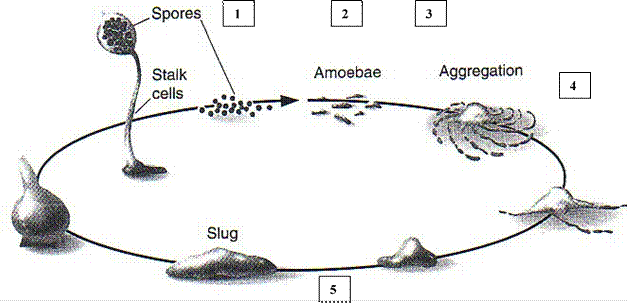
Fig. 2. The life cycle of Dictyostelium discoideum. Solitary
amoebae prey on bacteria in the forest soil. When prey becomes scarce, the
amoebae aggregate, first forming a mound of 1.000 to 100.000 cells. Then they
form a motile slug which moves up through the leaf litter towards light. Finally the slug develops
into a fruiting body, with a stalk formed of dead cells that hold up the remaining cells that sporulate, which can be
dispersed by the wind or transported by animals to a better location.
In the informational or semiotic
context we can describe these events during the life cycle of Dictyostelium
discoideum as follows:
1) Normal life situation: The
cell behaves in its “normal” way, under “normal environmental” conditions. The
free available energy DG°’ is the driving force
which feeds on an energetic level the metabolism of the individual cell and enables anabolic metabolism during
growth and reproduction of the informational polymeric molecules during cell
division.
2) Changing life situation:
As the environmental conditions change, which is the case, when resources are
getting scarce the cell starts to change its internal metabolic activities as a
result of starvation. We consider this change of activity within the cell as a
process of cognition, because it is a direct
consequence generated by the cell as an event that takes place outside
of the cell.
3) Reaction of changing life
situation: As a direct result of this cognition event the cell starts to
produce and release the signalling molecule cAMP. As mentioned above this
molecular agent is the product of a specific enzymatic reaction as a result of
inter-conversion of the ATP molecule. The signal molecule is released by a cell
and recognised by the mediation of specific receptors of another cell. This
cell by itself starts also to produce the signalling molecule and an
avalanche-like phenomenon can be observed as described in many research papers
over the past decade. Speaking
in biosemiotic terms this event can be understood as a co-operation-directed
form of communication.
4) Aggregation: The next
event that occurs is the development of a super-subject out of the former
co-subjects. This activity is a behaviour of the cell, that directly emerges as
consequence of the molecular communication process and can be described as form
of co-operation.
5) The collective behaviour
of this new cellular super–subject known as slug leads to a differentiated
organism with new structures (stalk cells and generative spores) and a new
function which is in this case the survival under altered environmental
conditions.
As described in this example with the
relative simple organism Dictyostelium discoideum, we see here an event
that can be analogized with events occurring in much more complex organisms and
that can be described as an very early stage in evolution where the notions
cognition, communication and co-operation already can be applied, if we try to
look through the lenses of biosemiotics.
References
Ellersdorfer,
Günther/Hofkirchner, Wolfgang (1994) Informationsstrukturen auf zellulärer
Ebene und Fragen des Reduktionismus/Antireduktionismus. In: Wessel, K.-F./Naumann, F. (Eds.) (1994)
Kommunikation und Humanontogenese. Bielefeld. Kleine.
pp. 105–115.
Fenzl, Norbert,
et al. (1996) On the Genesis of Information Structures. A View that is neither
Reductionist nor Holistic. In Kornwachs,
K./Jacoby, K. (Eds.) (1996) Information, New Questions to a
Multidisciplinary Concept. Berlin. Akademie Verlag. pp. 271–283.
Fenzl, Norbert/Hofkirchner, Wolfgang/Stockinger, Gottfried (Eds.) (1998) Information und Selbstorganisation. Annäherungen an eine
vereinheitlichte Theorie der Information. Innsbruck. Studienverlag
Gibson, James J. (1950) The
perception of the visual world. Boston. Houghton Mifflin.
Gibson, James J. (1966)
The senses considered as perceptual systems. Boston. Houghton Mifflin Gibson, James J. (1979) The
ecological approach to visual perception. Boston. Houghton Mifflin.
Hofkirchner, Wolfgang, Stockinger, Gottfried (2003)
Towards a Unified
Theory of Information. In: 404nOtF0und, Vol. 1 (3), N. 24 (Jan.).
Hofkirchner,
Wolfgang/Fuchs, Christian/Klauninger, Bert (2005) Informational Universe. A
Praxeo-Onto-Epistemological Approach. In:
Martikainen, Eeva (Ed.) (2005) Human
Approaches to the Universe. Interdisciplinary Studies. Helsinki. Luther-Agricola-Seura.
pp. 75-94.
Luhmann, Niklas (2001) Die
Gesellschaft der Gesellschaft. 2 vols. Frankfurt
am Main. Suhrkamp. Maturana, Humbero R./Varela,
Francisco J. (1992) The Tree of Knowledge. Boston. Shambala Piaget, Jean
(1976) Die Äquilibration der kognitiven Strukturen. Stuttgart:
Klett-Cotta.
Piaget, Jean (1980). Abriß
der genetischen Epistemologie. Stuttgart. Klett-Cotta.
Progogine, Ilya (1980). From being to becoming. San Francisco. Freeman.
Stryer, Lubert (1988)
Biochemistry. 3rd Edition.
New York. Freemann
and Company.