1. Introduction
As readers of this journal – or, readers of
practically any print or more likely digital publication – are aware, many in
developed capitalist economies are concerned about a looming crisis of
under-employment and job loss. Automation, generally, and artificial
intelligence, specifically, appear poised to displace the work of large numbers
of humans. Even as the full impact of AI on the future of work and workers
cannot be known, scholars have long decried the degradation and precarity of
many forms of employment in the new economy: the speed-up of digital labour,
the short term temporality of gig work, the lack of regulation and
accountability of employers via platform work, the theft of wages from workers
and the expansion of work into unpaid hours, deskilling and the loss of worker
control to digital surveillance, gendered and racialised stratification and
exploitation, intensified exposure to the speculation and instruments of
financial capitalism, and on (see, recently Pötzsch & Schamberger 2022, Demir
2024, Minotakis & Faras 2024, Liu 2025, Santos
2025).
This article examines the power of discourses of
technological unemployment and human obsolescence in the first decades of the
twentieth century and its mobilisation in arguments for old age pensions and
Social Security in the United States. These discourses were powerful in their
prevalence, impact, and seeming acceptance across groups of workers, labour and
social reformers, and even industrialists in advocating for and justifying
corporate and state welfare practices. At a larger level, this article argues
that as we analyse our contemporary moment, histories of technology and, more
importantly, histories of capitalism, can provide perspectives and inform strategies
for the present. Such historical work elucidates movements to resist
technology, regulate technological imposition, direct technological development
for social imperatives and sustainability, and demand the redistribution of the
forms of economic and time wealth generated by industrial and technological
change. Historical perspectives also remind us that current technologies have
not innovated on their own and do not proceed in a deterministic direction, but
rather have been developed and applied based on capitalists’ drive for
efficiency and profit. AI and automation’s contemporary threat to jobs may feel
existential, but history suggests that it is another stage in the long, ongoing
conflict between capital and workers (Minotakis &
Faras 2024, 631-632, Dyer-Witheford, Kjøsen & Steinhoff 2019, 69). This stage may
in fact be different, but historical study clarifies those divergences between
the past and the present, honing our visions for what might be possible in the
future.
With this in mind, contemporary theorists of work
and technology have begun to productively look to historical antecedents to
explain and demonstrate the practicality of a politics that respond to
capitalist priorities around work and technology, learning lessons from the
successes and limitations of the examples of Luddite resistance to the
technological changes of the Industrial Revolution (Noble 1995), feminist
movements’ struggles to redefine work, productivity and free time (Weeks 2011,
Hester and Srnicek 2023), decolonial and abolitionist positions against
techno-racial systems (Browne 2015, Benjamin 2023), workers’ persistent demands
for shorter work days and weeks (Hunnicutt 1988 & 2013, Roediger &
Foner 1989, Cutler 2004), workers’ organising for worker-led innovation and “socially
useful” and sustainable production (Nierling 2025), worker-recovered
and -run enterprises and worker cooperative movements (Srnicek &
Williams 2015), among others (Benanav &
Flores 2023).
Surprisingly, scholars have neglected the history
at the centre of this article – early twentieth-century discourses and demands
around technological unemployment that contributed to the winning of Social
Security and the large-scale establishment of retirement from work for older
adults in the US. Perhaps it is overlooked because it is seen as part of a
response to the larger economic crisis of the Great Depression, or because the
resulting New Deal policies were reformist rather than radical:
Keynesian-corporatist solutions to crises that would continue to reemerge. The
critiques of technological unemployment and obsolescence that led to the Social
Security solution were voiced by a broad political swathe of groups with a
range of political positions from anti-capitalist, humanitarian and
philanthropic, techno-utopian, and even reformist pro-capitalist, most with
racist, sexist, and ableist assumptions in their definitions of productivity
and social value. But the hegemony of the belief in technological unemployment
and obsolescence, and the breadth of the voices that spoke it, proved to have
been a strength when the moment came for their demands to be heard. That moment
was a product of economic crisis – the Great Depression – but it was also a
product of workers and organisers who drew attention to labour’s lifelong
exploitation and the possibility of greater liberation from work. And the
victory was not small: no less than the largest group of people in the US to
win guaranteed income from the state.
How did thinking about technological change,
specifically concerns about technological unemployment and human obsolescence
in the face of mechanisation, contribute to the winning of economic support for
older adults in the US? In the first of its multiple sections, this article lays
the groundwork for answering this question – or asking it at all – in political
economic approaches to media history and their potential for contributing critical
perspectives that elucidate both the past and present. The article then applies
this approach in explaining the development of the discourse around older
adults’ technological unemployment, expressed in those terms in the early
twentieth century, as well as, evocatively, as older adults being thrown on the
“industrial scrap heap”. The section that follows reminds us that it was not
the technologies themselves that hurt older workers, but instead their
application toward capitalist imperatives. Workers, organisers, and even the
scientific managers of the day saw work with machines as ageing workers, both physically
weathering workers and culturally constructing them as incompatible with new
technologies. Working within these assumptions, capitalists saw the removal of
older adults from work as potentially beneficial to firms and the economy and workers
and organisers saw the wealth of time and money generated by mechanisation as
potentially offering older workers relief from work. Part 4 argues that
workers, organisers and reformers mobilised these discourses from their various
political orientations in a “mass movement for old age support” in the early
twentieth century. Part 5 shows how these calls built upon – but also sometimes
ran counter to – longstanding related demands of shorter work hours,
unemployment protections, and other forms of universal or comprehensive forms
of social security. The article concludes, then, with a call for our awareness
of the ways in which critical discourses of capitalist application of
technology can be tremendously powerful and successful in making claims on the
forms of wealth produced by our labours – but that any potential resulting redistribution
of this wealth is susceptible to perceptions of who is deemed worthy, often in
terms of technology and labour, as defined by capital.
2. Foundations
This study brings together approaches from labour studies, history, and
media and communication studies, a triangulation essential for understanding
the historical moment at the centre of this article – the early twentieth
century – as well as our current one. It takes inspiration from Vincent Mosco’s
classic conceptualisation of the interrelated guiding commitments of work in the
political economy of communication: “history, the social totality, moral
philosophy, and praxis” (Mosco 2009, 81). Unlike conventional
media history focused on a disconnected historical moment’s text, technology,
industry or practice, what distinguishes a political economy orientation is a
commitment to analysing media history in the context of “the social whole or
the totality of social relations” of the historical moment (Mosco 2009, 16). Those interested in political economy look to
history, not only to historicise and trace the origins of the structures of power of the present, but also to
help us to see more clearly the dynamic,
conflictive forces within capitalism that drive history. Historical inquiry
reveals moments of historical change and reminds us of its possibility. Those
of us concerned with the political economy of the present may also draw conclusions from historical
class struggles as lessons for contemporary developments and challenges as we
seek a more just future (Mosco 2009, Fuchs 2024a).
Methodologically, this
article hopes to combine labour studies and related materialist traditions of
political economy with analysis of the logics, aesthetics and ideas from
cultural studies, or “ideology critique,” to examine the ways in which
discourses about work, technology, and the economy shaped both systems of power
and challenges to them (Marx 1867/1990, Mosco 2004, Fuchs 2024b, 133). In all
historical moments, ideas about capitalism are shaped by, but also shape, its
material realities. In the early twentieth century, beliefs about technological
and industrial change, and perceived human obsolescence in relation to it,
would shape the material realities of the modern life course.
Aaron Benanav (2019) has
persuasively written against putting automation at the centre of the economic
and labour history of the 20th century, arguing that unemployment in
the last two decades is due not to technological change but rather industrial
overcapacity and global competition leading to economic stagnation. Increased labour
productivity due to technological development generated income for corporations
and stockholders, which they put into financial capitalism’s instruments for
short-term profits and speculative investment, rather than productive
investments that would stimulate economic growth and employment. But while
arguing that automation explanations are misguided, Benanav
does assert that they have served important imaginative purposes in the history
of labour and capitalism. Citing Fredric Jameson, he sees automation discourses
and related postwork politics (which see a
technological solution to both unemployment and potential liberation from work)
as important forms of capitalist critique and attempts to imagine emancipatory,
utopian possibilities. But per Benanav they have not
generated real change, partly because the economic crises predicted by
automation critics have not appeared:
“Visions of automated factories then appeared again in the 1930s, 1950s and 1980s, before their re-emergence in the 2010s. Each time, they were accompanied or shortly followed by predictions of a coming age of ‘catastrophic unemployment and social breakdown’, which could be prevented only if society were reorganized. To point out the periodicity of this discourse is not to say that its accompanying social visions should be dismissed. For one thing, the technological breakthroughs presaged by automation discourse could still be achieved at any time: just because they were wrong in the past does not necessarily mean that they will always be wrong in the future. More than that, these visions of automation have clearly been generative in social terms: they point to certain utopian possibilities latent within modern capitalist societies. The error in their approach is merely to suppose that, via ongoing technological shifts, these utopian possibilities will imminently be revealed via a catastrophe of mass unemployment” (Benanav 2019 citing Bix 2000, 305-307).
But it is the historical moment right before
Benanav’s periodisation – the first decades of the
twentieth century – that is the exception that proves the rule. The critiques
of technological change that emerged in the late 19th century
continued through the early 20th century in multiple forms,
especially in concern about older workers, found evidence in the catastrophic
breakdown of the economy during the Great Depression and their arguments gained
purchase in some of the proposed solutions to the crisis. In Inventing
Ourselves Out of Jobs, Amy Sue Bix writes, “In the 1920s mechanizing
production seemed to guarantee prosperity; in the 1930s, people feared that changing
workplace technology might become America’s social and economic downfall”
(2000, 5). But the prosperity of the 1920s was not equally distributed, like
our own period of income inequality, nor were the guarantees of mechanised
production. Many of those labouring with machines saw them as threatening
unemployment and obsolescence, at least for older workers. They also saw the
potentially emancipatory possibility of technologically enabled reduction of
human labour through reduced working hours, and even technological
unemployment, through the large-scale retirement from work of older workers. These
logics and demands predated the 1930s, when the economic crisis allowed for
them to get traction in the proposals for old age pensions and Social Security.
Well before the Depression, in the early 20th century, workers,
social reformers, and even some businessmen were increasingly seeing the need
for forms of old age insurance and security. They argued that the historical
developments of capitalism in the late 19th and early 20th
centuries, including the growth of monopoly capital, capital investment in
technology and the mechanisation of labour, labour speed up, and associated age
discrimination against perceived inefficient older workers led to both the need
and possibility of systematising old age income and socialising the costs of
the social reproduction of the elderly (Oran 2017, 150).
This history also reminds us that the temporalities
of labour and life that we accept in our current moment are in large part
constructions of capitalist imperatives and state policy. With the resulting
federal old age insurance that came to be Social Security, both work and age
became defined in relation to each other, and both by industrial and
technological requirements. The terms of who was productive and who was not,
what kind of life was deserving of social protection, what kind of work merited
relief, how entitlements from the state could be justified in service to the
economy, and how the life course should be paced, became renegotiated for the
twentieth century and were built on discourses of technological unemployment
and human obsolescence. After decades of demands and debate, Social Security
encouraged the removal of a large group of workers from the workforce through
retirement to increase the employment of other younger workers. It defined
certain forms of waged, industrial labour as productive and deserving and left
other people’s work and lives unprotected. In this historical moment of the
early twentieth century when the temporality of the waged work day and working
life were not yet clearly fixed, we see can the foundation of our current
debates around technological unemployment, whose time is deemed productive, how
time away from waged work is defined, and the possibilities and pitfalls in the
ways demands for protection from labour exploitation and displacement are made.
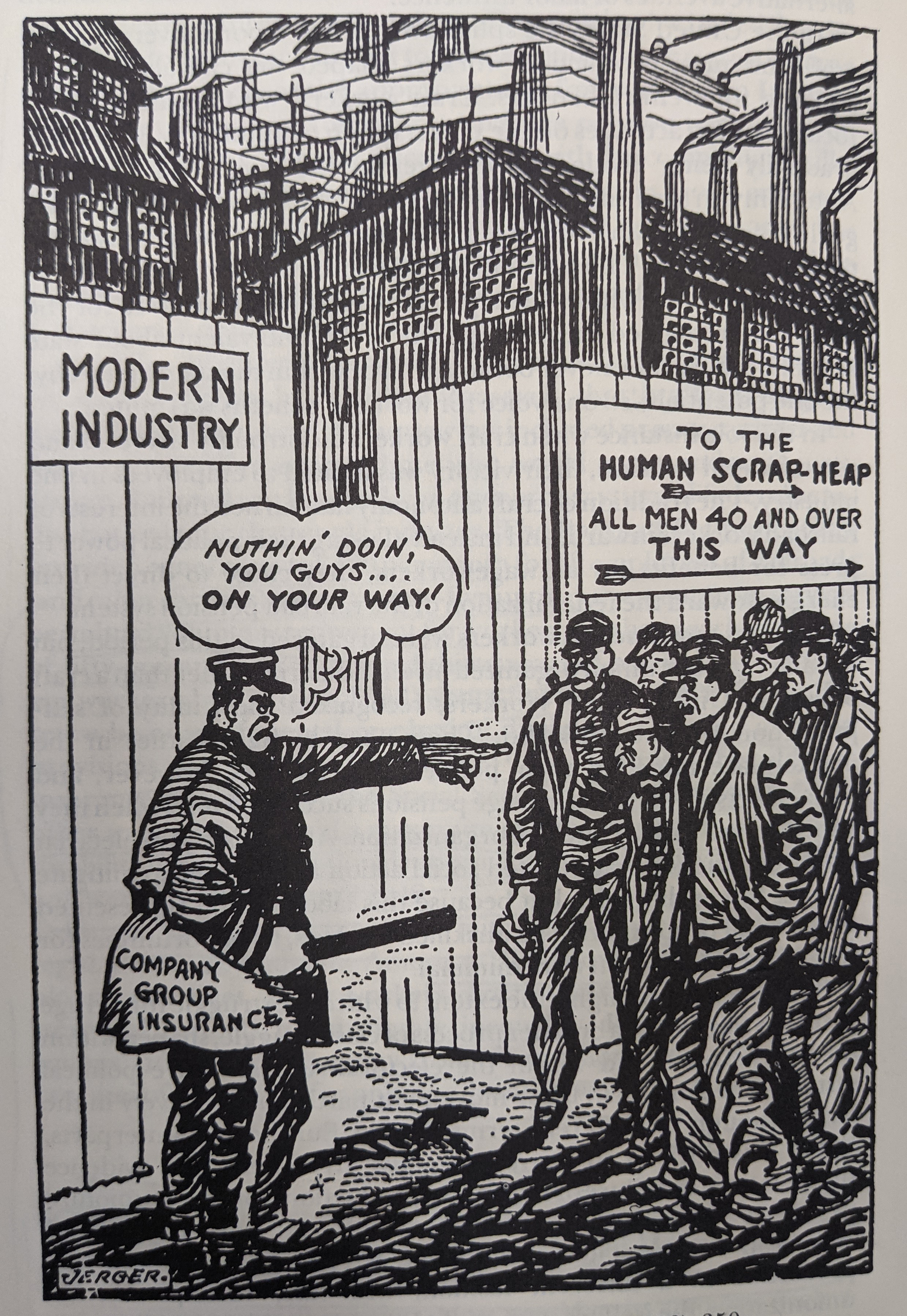
Figure 1: American Labor Legislation Review, December 1929, p. 350. Public domain.
3. The Industrial Scrap Heap
Workers, working-class
organisations and their allied social reform groups had long sought to address
the immiseration of their older members, loved ones, and future selves. But by
the beginning of the twentieth century, old age poverty due to lifetimes of low
wages was perceived to be further exacerbated by unemployment among older
workers. The labour movement and social reformers repeated a common refrain: older workers were being thrown on the
“industrial scrap heap,” worn out by mechanised labour and facing age
discrimination in modern industry (Devine 1908, Todd 1915, Epstein 1922 &
1929, Rubinow 1913 &1934, Squier 1912, Haber 2000, 32). A representative at the 1921 convention of the Ohio
State Labor Federation urged passage of a resolution calling for a state
pension system “‘so that those who are on the scrap heap of industry will not
have to spend their last days in charitable institutions’” (Anglim & Gratton 1987, 97-98). Delegates at the 1921 Illinois State Labor Federation
in the same year used almost the same language: charging that it was “‘a crime
to throw [old workers] into the scrap heap, to go the slow starvation route’”
when they were used up by industry and had become “‘disabled through old age’”
(Anglim & Gratton 1987, 97). At the 1928 American Federation of Labor
convention, President Wiliam Green described machine-related labour
displacement as among “‘the most important problems affecting labour today’”
(Bix 2000, 14). The message continued through the decade with a number of state
labour conventions expressing concern about the impact of rapid mechanisation; months
before the stock market crash, the 1929 Iowa State Federation of Labor sent a
telegram directly to the White House imploring President Hoover to think about
convening a special economic conference and providing relief for the “‘growing
army of the unemployed due to the encroachments of the machine age’” (Bix 2000,
15). The International Workers of the World used stronger language in their
1925 publication, Unemployment and the Machine, predicting no “limits to the unemployment of the future” due to
machine-replacement of men, demanding a 6-hour day so that jobs might be shared
among more workers (MacDonald 1925 in Bix 2000, 13).
“By the late 1920s, technology was one of the most
common explanations of the employment problems of older workers,” historian of
retirement William Graebner has argued (1980, 21). A new phrase was coined,
“technological unemployment” (Jacoby 1985, 168), and it became the
justification for demands of workers, inspired broad social movements, drove
research by federal commissions and Congressional investigations, and even was
used by industrialists and Taylorist scientific
managers (New York Times 1928, 15, Christian Science Monitor 1929a,
3, Christian Science Monitor 1929b, 7). Although the unemployment rate was low
in the 1920s, economic historians argue that this concealed painful change for
workers: the high rate of
investment in labour-saving equipment and production plants drove job
displacement, workers were pushed out of their manufacturing jobs and forced to
look for new ones, while the new service sector industries were slow to absorb
dislocated workers (Jacoby 1985, 167-170). The workers, organisers, and social
reformers of the time argued that the application of these new technologies and
the mechanisation of industries disproportionately impacted older workers.
Much of the push
for pensions and old age security happened through Progressive era middle-class
organisations and social reformers who studied old age poverty, published
widely, and advocated for policies on the state and federal level through organisations
such as the American Association for Labor Legislation and the American
Association for Old Age Insurance (later the American Association for Social
Security). The leading proponents of old age security of the first decades of
the twentieth century, the likes of Abraham Epstein and I.M. Rubinow, diagnosed
old age poverty as a product of modern industry and the speed and intensity at
which it ran, and wore down workers. In his 1922 Facing Old Age: A Study of
Old Age Dependency in the United States and Old Age Pensions, Abraham Epstein said this way: “It seems obvious that
modern industry finds little use for the worn-out workers. It replaces and
discards these aged wage-earners as it is in the habit of replacing and
discarding the worn-out and inefficient machinery […] Modern machine industry
[has] less need for expertness and experience and greater use of speed and
rapid production. As a result, the younger generation, though less experienced,
is continuously crowding out the older and less efficient workers” (Epstein
1922, 20). Epstein brought his arguments to
his leadership of the Pennsylvania Commission on Old Age Pensions,
drafting Pennsylvania’s progressive and short-lived old age pension bill in
1921, before organising the American Association for Old Age Insurance. Similarly,
medical doctor and economist
I.M. Rubinow, one of the foremost theorists of social insurance who influenced
decades of social reformers (and two Roosevelts) saw old age as defined by
industry, by the “wage-system,” by the “constant speeding up of industrial
processes,” such that older workers would be “disabled,” not by physiology but
the economy: “The economic disability of old age may arise suddenly
while the aging worker is still fit for productive activity, but finds himself
below the minimum level of productivity set by the employer […] Industrial
efficiency, scientific management, Taylor system – these are all forces […] to
use up human energy at greater speed […] and to dispense with it immediately
when its high degree of efficiency begins to decline” (Rubinow 1913, 304-305).
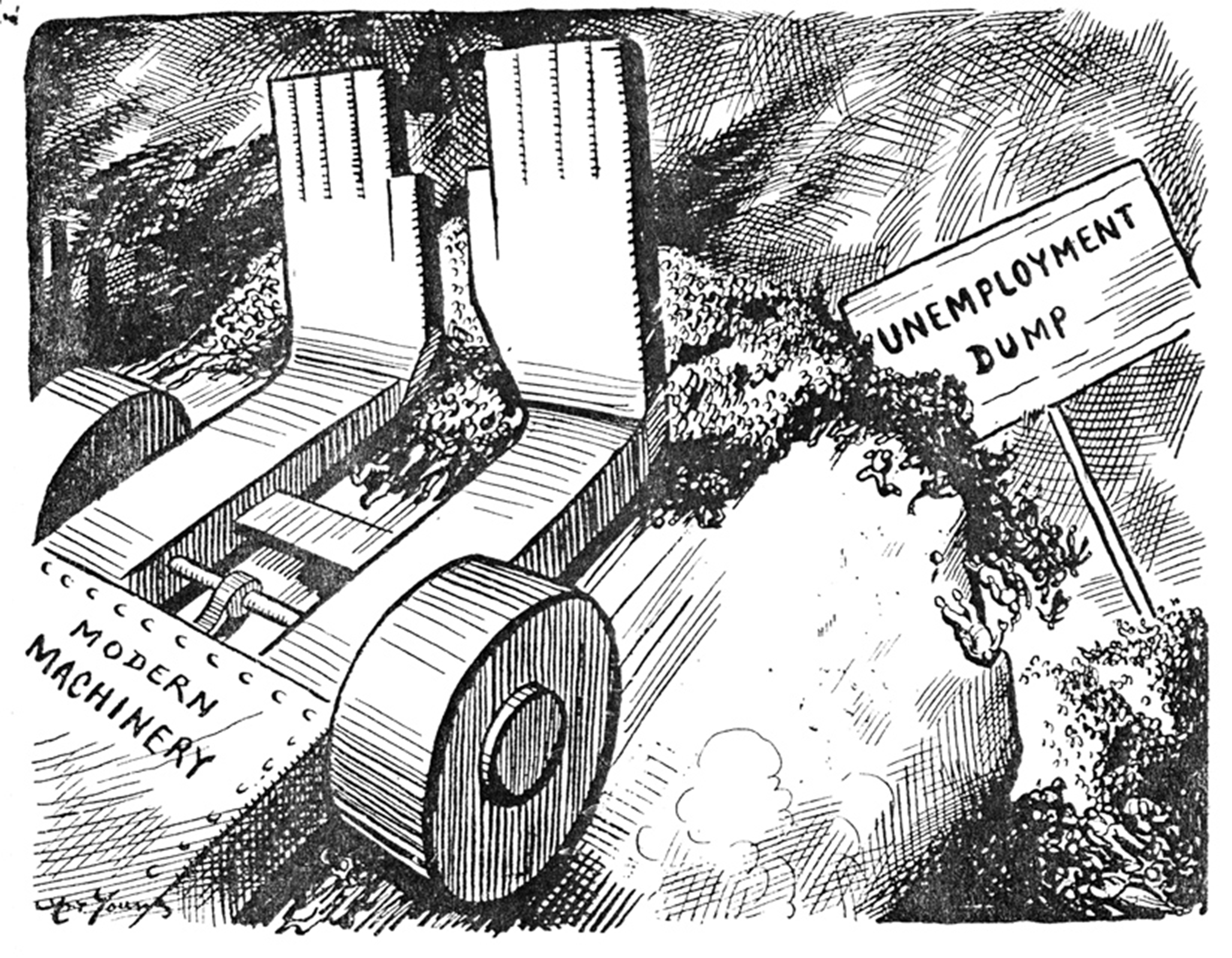
Figure 2: Art Young for Industrial Workers of the World (IWW) publication, The Industrial Pioneer, 1924; Reprinted on the cover of J. A. MacDonald, Unemployment and the Machine (Industrial Workers of the World, 1925). Public domain.
Writing by economists and physicians at the
time accepted the theory of technological unemployment, but justified its
logics in ageist terms, arguing that the problem did not reside in the
technology, but rather in the older workers. Older workers were inflexible and
maladaptive, explaining the technological unemployment as deserved due to
intrinsic differences in older bodies, brains, and personalities (Graebner
1980, 21). Older workers were deemed inefficient, physically limited, and
mentally unable to adapt to the increased mechanisation and accelerated speed
of production. The term still used at the time to define a separation from work
due to old age, or to “be retired,” was “superannuation,” or, in Latin to be
“over” in “years,” and in common parlance to be outdated and declared obsolete.
Superannuation in the early twentieth century became “old age as defined by
industrial requirements” (Graebner 1980, 137) which assumed a human
technological obsolescence, the end of a “technological life” of a worker, who
had a finite timespan of labour due to industrial and technological change. “Technology
produced superannuated workers” (Graebner 1980, 23).
Such ageist assumptions, defined in relation to
industrial and technological change, justified the unemployment of older
workers. “According to the New York State Commission on Old Age Security, 89
percent of manufacturing firms discriminated against job candidates past middle
age, while 59 percent refused even to accept applications from older workers”
(Bix 2000, 34). The American Federation of Labor pointed to studies of the
“elimination of the middle-aged man in industry” that “indicated that the most
frequent limit for unskilled labour is 40 and for skilled labour 45 years […] the
effect of speed and mass production on the policy of barring the doors to the
employment of men over middle age” (New York Times 1929, 28). Older
workers “‘are eliminated as ruthlessly as the machinery whenever it begins to
show wear’” the New York Times quoted the AFL report (1929,
28).
A Yale industrial engineer argued that modern science was increasing the
health and lifespan of older workers and the increased mechanisation might
actually make aging less of a drawback in modern industry, doing the heavy
lifting and offsetting declines in endurance, yet, ironically, the modern
emphasis on rapid technological change had started shrinking the period of
employability. Executives and managers perceived older workers as out of step
with the Machine Age, and younger workers more flexible and knowledgeable in
adapting to new technology (Bix 2000, 34).
4. Technology for Capitalist Imperatives
It was not the imposition of new
technologies, but their application for capitalist imperatives that threatened
older adults’ employment. And many older workers and their labour organisations
did not place the blame on the machines in and of themselves. They had a more
nuanced interpretation: it was not the technology, but rather the speed at
which it was operated that threatened older workers (Graebner 1980, 19). This
new capitalist mode of production “placed a premium on youthful vigor” (Graebner 1980, 21) run by scientific managers
hoping to maximise the efficiency of workers. Older workers were phased out for
younger men whose bodies, brains, and practices would be more compatible with Taylorised production: workers with better eyesight, more
speed, and more endurance; workers who would not stall the whole production
line with breaks for rest or the bathroom, who did not drink as much alcohol
during the day, did not have flexible interpretation of work hours, or were not
as inflexible in their ways of work. To keep this speed up, age limits in
hiring were becoming more commonplace in industries, incrementally replacing an
older workforce, and some firms took the unpopular action of firing older employees
(Graebner 1980, 22). Labour historians have documented how, among printers
(Graebner 1980), machinists (Montgomery 1980), and steel workers (Stone 2004),
older workers were replaced with younger. More common than firing older
workers, workers were moved to less skilled jobs. The period’s focus on
improving industrial efficiency through new technology (both machines that
workers worked with and stopwatches and timeclocks that measured their labour)
was wrought both by speed and through the division of labour that separated
expertise from execution (Gutman 1976, Thompson 1968, Montgomery 1980). The
experience, knowledge, skills, work habits, and cultures of older skilled
craftsmen no longer held the same value for bosses and could even be seen as a
detriment to modern industrial work processes (Williamson, Shindul
& Evans 1985, 75).
Herbert Hoover’s Committee on Recent Economic
Changes of the President's Conference on Unemployment boiled the changes down
to the first word of its 1929 report: “acceleration” (Committee on Recent
Economic Changes 1929, ix). The committee found that increased speed of
production and “productivity per man-hour”, via electrification, modern
machinery, and scientific management was resulting in technological
unemployment: “workers displaced by the introduction of machinery or improved
processes” (xvii). “[T]he time has come
to devote continuing attention not only to the problems of cyclical
unemployment but also to this newer problem of 'technological' unemployment if
we are to forestall hardship and uncertainty in the lives of the workers,"
the Committee asserted (xvii).
Communications industries were locations of
significant technological development, and in the context of print, worker displacement.
Printers saw significant changes to their employment and labour. Historians of
print workers note that while “the fear of human
displacement was common enough” in broader society, among printers it was more
severe (Thompson 2024, 317). Of the challenges faced by his union of
Philadelphia workers, the local president asserted, “none have had more
disastrous effects than the types-setting machines that are now in almost every
newspaper and large book and job office in the country” (Moloshok
2014, 5). “Between 1895 and 1915, older workers were
phased out for younger men with better eyesight, more speed, and more
endurance” for working with these machines (Graebner 1980, 22). A 74-year-old
member of the Dayton Typographical Union who resided in the Union Printers’
Home put his understanding of the experience of the technological unemployment
by the Linotype machine into verse in the Inland Printer in 1911:
The typo’s old
pick from the case
Has changed to
machine’s rapid pace –
To iron
and steel,
To
shafting and wheel,
And the keyboard
has taken his place.
The clinking old
rule and the stick,
With their
time-beating, rattling click,
Are now
laid away,
And
slow ‘prints’ and gray
Are ‘out’ by a
Linotype trick.
Adieu to the
‘strings’ and the paste,
To the longest we
often have raced;
Old-timers
are ‘out,’
But the
young comp.’s about
And filling up
columns with haste (Graebner 1980, 22).
“It was generally
recognized that revolutionary technological changes in printing had destroyed
or severely undermined the ability of older printers” and, as a result the International
Typographical Union (ITU) that represented them “was the scene of an extensive
debate over the pension in the first decade of the century” (Graebner 1980,
135). Among union members, pensions were seen as “a logical response to
superannuation brought on by changes in technology and by the high speeds at
which capitalists chose to operate the new machinery” (Graebner 1980, 135). As a
Bureau of Labor Statistics report described the shift to “machine composition”
in the first decades of the twentieth century, “three
or four hands were eliminated, out of every five formerly engaged in setting
and distributing type. Consequently, the adoption of the machine method
displaced a great number of typesetters” (US Department of Labor 1929, 10-11).
Most workers were absorbed by the rapid expansion of the print industry during
the boom in the number of newspapers and periodicals in the early twentieth
century, economists of the time argued. But older workers and those deemed
unsuitable for using the new machines were shifted to less skilled jobs or took
the union pension if available to them. Even with the growth of the number of
print workers overall in the US, an economist worried about the potential for
additional oncoming unemployment, “closer analysis, however, discloses the fact
that despite the expansion of commercial printing up to 1930, which gave
employment to an increasing number of pressroom workers from year to year,
fewer men have been employed to each one hundred of the newer presses than to
each one hundred of the old. And this is a fact which opens opportunity for
speculation as to the trend of employment as the new presses continue to
replace the old” (Faulkner Baker 1932, 670).
Film, itself a modern industry, made more visible the precarity of
older workers because of their perceived inefficiency. The imprinting of
the issue in the popular imagination can be seen in D.W. Griffith’s 1911 film What
Shall We Do With Our Old? With the title card, “Founded upon an actual
occurrence,” it was perhaps one of the first examples of a “based on a true
story” caption. With this assertion of truth and Griffith’s typical concern for
social dramas and their effect on (white) men, he portrays a foreman firing a
series of older workers who are replaced in rapid succession with younger,
bigger, presumably stronger and faster men. The film helped solidify the popular
understanding of human obsolescence as a modern labour and social problem – the
almost mechanistic replacement of older workers with younger ones and the
resulting unemployment of older men – with the speed and realism of the new
medium of film, itself replacing older forms of evidence and entertainment.

Figure 3: National
Child Labor Committee Exhibit Panel with Lewis Hine photos, circa 1913, Library
of Congress Prints and Photographs Division, LOT 7483, v. 2, no. 3518. Public domain.
Pension advocates argued that the conditions of
modern industrial life, technological imposition and speed-ups, wore workers
out, weathering them before their time. The industrial worker was being “used
up” by industrial capitalism as the Massachusetts Special Commission on Social
Insurance asserted in 1916 (Anglim
& Gratton 1987, 101). A
leader of the New Bedford Association of Cotton Weavers argued that
the faster speed of the looms wore workers out, necessitating pensions for
older workers: “‘If you can tax people for war, you can tax them for the
industrial war which has made them grow old’” (Anglim & Gratton 1987, 100). The discourse of industrial weathering
was prominent in labour reformers’ advocacy for workers in this time period. The
arguments against child labour often portrayed a shortened life course for
children who lost years to industrial labour which prematurely aged them. With
this logic, technological change accelerated both workers’ obsolescence, making
them outdated or no longer useful, as well as their senescence – drawing
attention to the natural declension of older age and intensifying it through
the work conditions of modern industry.
Even much of the business community was concerned
about what they framed as technological unemployment: “‘Labor-saving machinery,’”
commented the Commercial and Financial Chronicle in 1929, “‘had
displaced men and reduced opportunity’” (Graebner 1980, 21). Workers were being
replaced by machines, or at least, machines were taking control of work
processes and taking away the skilled craft production of older workers. It was
these arguments of technological unemployment, or for them more compellingly,
the technological unemployability of older workers, that persuaded some
industrialists in the 1910s and 20s to establish retirement and pension plans
as “one answer to the problem of removing older workers from the work force”
(Williamson, Shindul & Evans 1985, 76). Superannuation
assumed technological obsolescence and senescence, and thus a limit to one’s
“work-life,” at its best, compelled by the financial promise of a pension.
The Taylor Society’s scientific management-minded
members were also concerned with how to maximise productivity through machines
if they also seemed to tire and drain industrial workers, as well as how to
address labour’s demands for a share in the wealth of that productivity. Should
workers be given a “Shorter Work-Life or Work-Week,” they asked in their winter
meeting and published in their Bulletin in 1928, as workers seemed to be
demanding both. The American Federation of Labor was campaigning for a 5-day
work week, and older workers wanted economic security when they would no longer
work, decided either by their boss or themselves. The industrialists,
scientific managers, professors, and social reformers of the Tayor Society
focused on the effects of “mechanisation” and the “technological unemployment”
of older workers “who in old age have become maladjusted because of physical
infirmity or obsolescence of skill. It is in the first half of a generation’s
life that it is fresh, strong, plastic, adaptable and highly productive; and in
the second half that it is relatively weak, fatigued, inflexible, and
non-adaptable to new technological processes,” as articulated by the Taylor
Society’s managing director (1928, 231).
Remarkably, they openly debated corporate pensions,
state-run pensions and social insurance, while also placing faith in their
existing methods – that “the maximum amount of work, scientifically determined,
that workers can do and thrive under” could be identified and govern the
standard length of the work period (day, week, life). “That we are in a
scientific industrial age; that our progression is rapid; that our production
is increasing; that men are too largely absorbed by the machine and machine
processes; that we know there is a problem in social adjustment; should admit
that we know it; and that we have precedent for solving it” (Taylor Society 1928,
246). Their precedent was the industrial engineering they had already wrought
on labour that, in many ways, had produced the problem in front of them. They
expressed similar confidence in their power to wield technology to solve this
problem: that “a substantial portion of the larger social income which results
from marked increase in technological efficiency should be handled after the
manner of a credit to be drawn upon by workers after middle age, when physical
capacity and productivity decrease as a result of age and of inflexibility in
adjustment to new technological conditions” (Taylor Society 1928, 230). While
some middle class Taylorists had concerns about how
workers might spend their newly acquired free time and money, others assured
that “that workers will learn to live when our production machinery makes it
possible” (Taylor Society 1928, 246). The issue of the technological
obsolescence and unemployment of older workers was urgent for workers, they
repeated again in 1929, just before the stock market crash, expressing concern
about age discrimination for workers at ages as young as 45 for men and 35 for
women (Taylor Society 1929, 226-228). “With the
rapidity with which they are putting machines into various industries and
eliminating all forms of manual labour, if we forecast the future in the light
of the present, we have every reason to believe it is going to be worse rather
than better” (Taylor Society 1929, 226-223).
5. A Mass Movement for Old Age Support
This period’s “mass movement for old age support,”
as historian Jennifer Klein calls it, mobilised not just unionists and
leftists, but also previously unorganised older unemployed persons who built
and joined a number of organisations to demand pensions from industries and the
state, and even more powerfully, used “old-age poverty and dependency to spark
a national debate” on economic security in the US (2006, 67-69)[1]. Workers and their labour organisations argued that
older workers were vulnerable to unemployment and obsolescence, being pushed
out or worn out by the technological speed-ups of modern industrial life. They
pushed for pensions, arguing that saving for old age was impossible given wages
and the cost of living, acting to prevent the impoverishment of their fellow
workers and future selves. Younger workers were also concerned about their
current employment, worried that desperate older workers would accept lower
wages and thus both drive wages down and threaten the employment of younger
workers (Anglim & Gratton 1987, 102).
The
issue of old age pensions garnered “sustained and vigorous” support from
rank-and-file labour representatives (Anglim & Gratton 1987, 102). But
the national leadership of the American Federation of Labor took public stands
against state pension programs for years through the 1920s, followed by weak
gestures in their support, because of the leadership’s “anti-statism” and
interest in labour autonomy, which translated into suspicion of social welfare
from the state. The AFL national convention “urged that individual unions
develop their own pensions, apparently to avoid dependence on the state” (Anglim &
Gratton 1987, 92). But state-level federations of labour regularly
violated the national AFL line on public old age relief by consistently passing
resolutions in support of old age pensions, campaigning for them through their labour
and fraternal organisations, and lobbying politicians for state-level public
pension legislation. Labour federations debated various old age security
schemes for workers (for example, advocating for noncontributory
state pensions over those that would “tax” the working class by requiring them
to pay into them) and succeeded in winning state-level public pensions in
several states in the 1910s and 20s, however small and inconsistent the support
they provided older workers (Anglim & Gratton 1987, 93-99).
Old age
pensions backed by the government were appealing to many because of organised labour’s
conflicted relationship with private, employer pensions, however few and small
they were in the early twentieth century. Unions worried that the corporate
paternalism of the pensions might build loyalty to the employer, make workers
more docile, and become a form of employer control over workers. Private, noncontributory employer pensions were not portable if a
worker moved jobs or in the case of certain forms of termination. During labour
actions, the loss of an employer pension could be used as a threat to draw
older workers back into work as scabs. To try to combat this, unions even took
up the financial support of older workers who lost pensions or employment
during strikes, a kind of makeshift old age security out of working-class
solidarity. Pensions might conscript workers into investing in the company’s
profit motive and the boss’s managerial logics with the existence of the
pension relying on the success of the company. Labour organisations also blamed
pensions from the federal government (such as war pensions) and private
employers for serving to establish age limits for employment across industries,
implying ceilings to the productivity of older workers. Forms of group
insurance and workmen’s compensation also inadvertently motivated employers to
push out older workers, who were deemed costly risks (New York Times 1929,
28). But workers still wanted greater economic security in their older age, and
when labour unions did not advocate for old age support as vociferously as
members wanted, they sometimes mobilised outside the traditional union
leadership; for example, railroad workers organised the Railroad
Employees National Pension Association when they were dissatisfied that
pensions were not central to their unions’ demands. Unions negotiated this
complex terrain of fighting for old age support for their members by pushing
for greater worker autonomy through more portable contributory pension schemes,
advocating for public pension programs, and creating other forms of union-provided
old age support. In the demand for public pensions, unions, county and
state labour federations, and social workers and reformers collaborated in “a
broad working-class political effort” (Anglim
& Gratton 1987, 102) for old age
security.
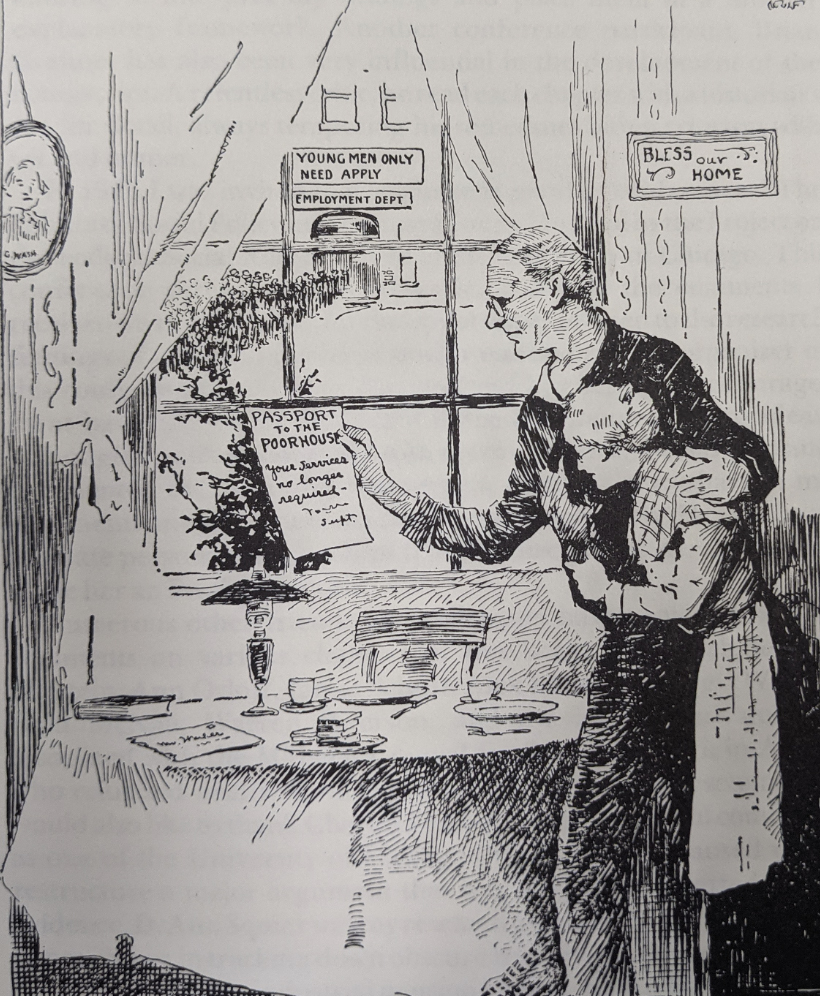
Figure 4: The Eagle Magazine, January
1925, p. 10. Public
domain.
Fraternal societies had long attempted to provide
economic security to their middle- and working-class members through forms of
mutual aid, life insurance, and old age care. It was a working-class fraternal organisation,
the Fraternal Order of the Eagles, that most vocally agitated for public
legislation for old age pensions in the first decades of the twentieth century[2]. The Eagles mobilised
the language of technological and industrial change to suggest that older
workers were deserving of economic support. Frank Hering, head of the Eagles
(and former Notre Dame football coach), asserted that older workers were
“simply victims of an economic system” that was installing “swift-speeding
modern machinery” that was overtaking them. Evoking loud veterans and war
applied to the industrial changes in the US, evoking nationalism,
industrialism, and the successful example of widespread pensions for Civil War
veterans, Hering and the Eagles called for pensions for “age disabled veterans
in our Country’s industrial army” (Hering 1922,
5). Eagles created an Old-Age Pension League to push local and state
governments toward pension legislation. In Milwaukee, the four thousand Eagles
were able to enrol ten thousand people in the League. They hosted speakers,
distributed pamphlets and even rented a theatre to put on a production about
the ravages of old age, followed by an appeal to join the pension league
(Chappel 2024, 59). While drawing greater attention to the issue of old age
poverty, the Eagle’s vision of change was limited, perhaps by its white male,
mostly middle-class membership, who saw those in need as industrial workers
that looked like them (Chappel 2024, 59 & 34-35).
Were older adults actually becoming technologically
unemployed and in need of economic assistance? The discourses around
technological unemployment and its effects on a group of people, older adults
in the US, were powerful and persuasive – but they were not entirely
representative of the experience of older workers. In fact, there is extensive
historiographic debate over the causes and extent of old age poverty in the
early twentieth century and whether industrialisation
increased or diminished old-age dependency. Historians have dispensed with
narratives that portray pre-industrial agrarian life as the “good old times” to
grow old and, in contrast, the modern economy producing pauperisation amongst
the old through the dissolution of traditional economic and familial supports
and industrialisation and the technological processes of modern factory labour,
weathering workers or being incompatible with their declining minds and bodies.
On the other side of what has been framed as a “modernisation” debate (Haber
& Gratton 1994, 206, Winant 2021, 78) historians have seen the industrial economy as
both offering more opportunity for wealth for the old while also producing the
old as a distinct population and subject to control with pensions and Social
Security creating old age as a period of dependency. The unemployment
rate was low in the 1920s, but as mentioned above, there was painful job
displacement for older workers (Jacoby 1985, 167-170). There
is significant historical evidence that older adults were still in the paid
workforce even in the Depression – the 1930 census showed 70 per cent of men
and 11 per cent of women aged 65-69 reported themselves working, although they
were more often employed in areas like agriculture and domestic work. The
census data has been notoriously difficult to read for economic and
social historians: it at once gives the impression that retirement first
emerged in the later nineteenth century, but analysis of the US and British
censuses (there appear to be no equivalent studies of other countries)
demonstrates that most of the apparent nineteenth century decline in employment
at older ages was largely due to the decline of agriculture (Thane 2003, 100).
Retirement from white-collar occupations, combined with improved occupational
pensions, was visible through the first half of the twentieth century. And many older adults had other forms of financial
support that allowed for a version of retirement – private and public (state or
federal government, often military) pensions, savings, money provided by
children, or property ownership that allowed for the promise of inheritance to
younger generations in return for care in the owner’s old age (Haber &
Gratton 1994, 206, Chappel 2024,
37-40, Gratton 1996, Carter & Sutch
1996, Hartog 2012).
Poorer older adults had
to piece together multiple forms of work in an “economy of makeshifts,” that
would keep them in the census work numbers and also in precarious economic
positions (Thane 2003, 100). “This
unremitting lifetime toil was relieved for the poorest people with the
emergence of retirement as a normal phase of life only in the mid twentieth
century” (Thane 2003, 99). Retirement did not become a widespread expectation
until the availability of Social Security in the 1940s,
and even then, because the program’s payroll-based system excluded major job
sectors as well as informal and unpaid social reproductive work, a significant
share of Black Americans, women, and rural labourers were left out (Thane 2003, 99-100). What is most interesting, regardless of how well older
adults were actually weathering industrialisation and the modern economy, in
the early twentieth century, the thinking and discourses about industrialisation
– and specifically technological change’s impact on older workers – by labour,
social reformers, and industrialists themselves was leveraged to win pensions
and eventually Social Security for older adults in the US.
As the country sunk into the economic crisis of the
Depression, working class people demanded old age support through their unions,
fraternal and social organisations, and groups specifically formed to advocate
for federal and state pensions for older adults, partnering with social reform organisations
and following populist political leaders. By the early 1930s, they had won
public pensions for the indigent aged in 30 US states (Anglim & Gratton 1987, 94-95, Amenta &
Zylan 1991, 251 & 256). Concern about technological unemployment was
central to most of these organisations, across their political positions. The onset of
the Great Depression led more people to blame technology for the now widespread
unemployment, and the inability of economists to explain the
cause of the crisis made these groups’ arguments more persuasive (Akin 1977,
75).
By 1930, John Maynard Keynes had adopted the phrase
already in use in popular writing and thought, “technological unemployment,”
asserting it was a “temporary phase of maladjustment” when the “increase of technical efficiency has been taking place faster than
we can deal with the problem of labour absorption” (Keynes
1930/1932, 364 and 358). He countered the economic pessimism of the moment with
an ageist metaphor: the US was “suffering, not from the
rheumatics of old age, but from the growing-pains of over-rapid changes” (Keynes
1930/1932, 358). Keynes predicted that in one hundred years
(by 2030), technological change and capital accumulation would have brought
about increased standards of living, reduced working hours (around 15 hours a
week), and the solution to the “economic problem” of scarcity, leaving humanity
with the challenge of using their leisure time wisely. A different view
of technological unemployment had been articulated decades earlier, by Karl Marx who saw capitalists
applying technology to displace workers to exploit the remaining ones more
intensely: “The machine […] is a means for producing surplus-value […] not only
by replacing labour-power, but by subjecting the labour-power that remains more
thoroughly to capital” (Marx 1867/1990, 492).
The machine production
of this reserve army of the unemployed was a functional, structural product of
capitalism that intensified the exploitation of employed workers, not just a
temporary product of labour displacement from new industrial technologies.
Technological application under capitalism would worsen inequality, Marx
suggested, not lead to an affluence of wealth and time for all, unless
revolutionary political and social changes abolished private ownership and
enacted collective control over the means of production. Even among mainstream
economists, technological unemployment arguments were gaining greater purchase.
Ewan Clague, a labour economist and future Commissioner of Labor Statistics for
the Department of Labor predicted “the so-called technological unemployment of
which we have heard so much during the depression […] will continue to large"
(1935). Other economists disagreed with the diagnosis, seeking out other supply-side
reasons for the crisis. But this reformist (Keynes) and revolutionary (Marx)
thinking would inspire thinking on the left about the risks and potential of
technological change for workers, young and old.
In the 1930s, the Townsend Movement mobilised older
adults and others around demand-side and technological unemployment solutions
to the Depression, proposing the leveraging of a new structural position for
older adults in the economy. The Townsend Plan was organised around generous
monthly payments to all Americans over the age of sixty. The Townsend Plan held
that less and less labour power would be needed to run the machines of modern
business, which would create unemployment but also enable freedom from work in
youth and old age – two stages in the life course they defined in relation to
absence from work with machines, which would be intensified during middle age
(Amenta 2006, 43). “Manpower, from 20 to 60 years of age, plus modern machines
in mine, mill, factory & farm will provide a high standard of life for
every man, woman and child in the US,” the Townsend Plan proposed, as illustrated
in “The Span of Life from Birth to Death” (below).
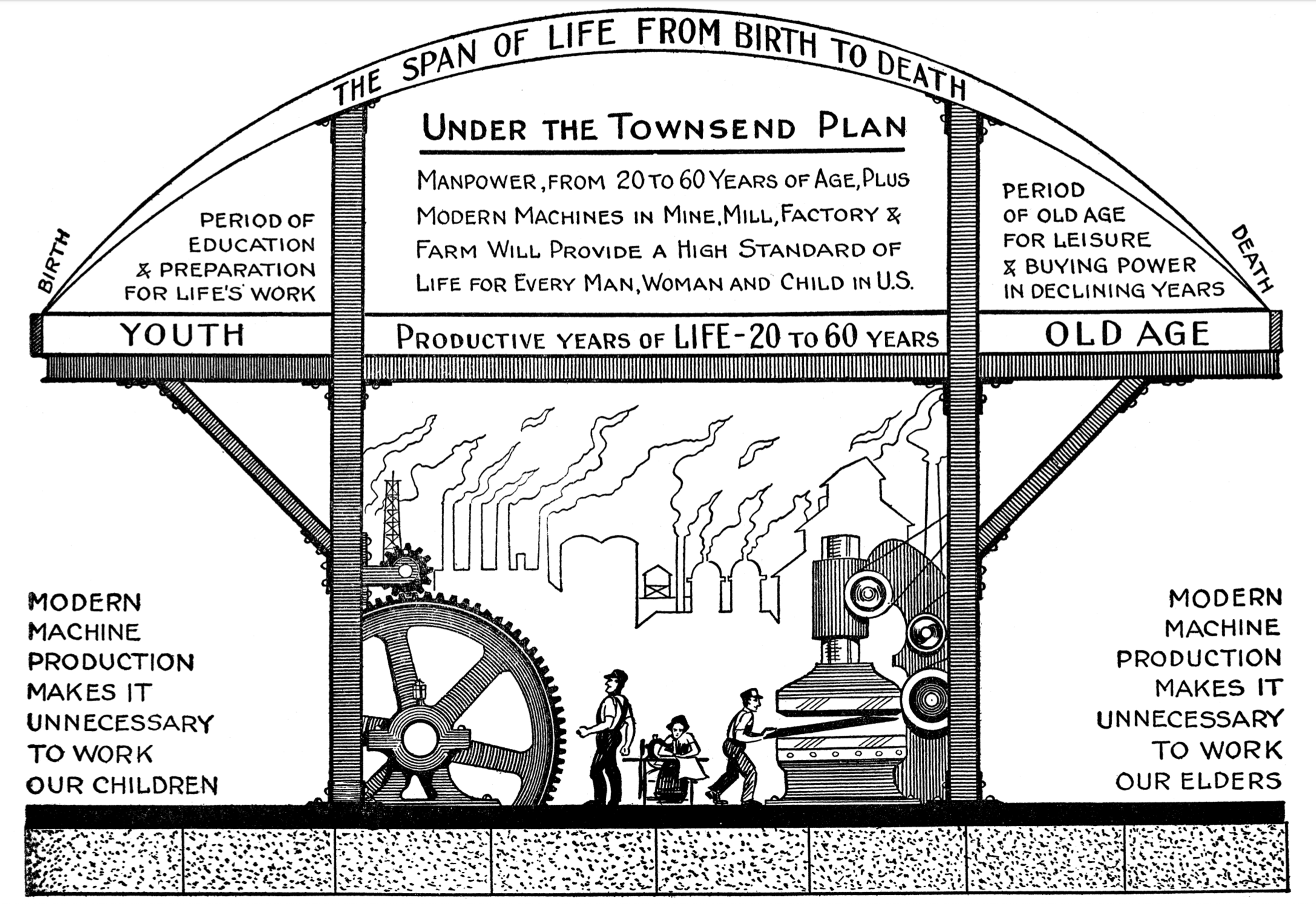
Figure 5: J.W. Brinton, The Townsend
National Recovery Plan: The Solution of Your Problem (Chicago, Townsend
National Weekly, 1936), pp. 48-49. Public domain, copyright expired according
to
https://exhibits.stanford.edu/copyrightrenewals
and
https://vcc.copyright.gov/browse
(accessed on 4 May 2025).
Recipients would receive a high monthly pension,
which they would have to spend each month completely. The Plan thus had
multiple aims: to lift the poor old out of poverty, remove them from the labour
market to stop their competition for jobs with younger workers, and compel
their spending to stimulate the economy. Older adults would retire from work
but become productive through consumption. Unlike proposals from the Fraternal
Order of Eagles or organised labour in the US, the Townsend Plan was truly
universal – at least for every person over the age of 60 – not means-tested or
even based on work or income generated at earlier ages. This universal social
support for older adults would be paid for through a new tax, not taken from
workers’ own contributions (as Social Security would later propose).
While
this support was progressive in its universality and influenced by socialist
orientations, it was far from a critique of American capitalism or a Marxist
proposal for worker control of the means of production; the Townsend Movement
was nationalistic and its official organs celebrated the basic current
structure of American capitalism, which could and should continue to grow in
their view, the growth of the economy would provide their hoped-for economic
benefits. And while universal across class, race, and gender for older adults,
these benefits would not be dispersed to everyone across the generations, for
example, more machines might enable shorter work hours for all people. Instead,
as their motto proclaimed, it was “Youth for Work, Age for Leisure.” The
Townsend Movement claimed millions of proponents via Townsend Clubs,
door-to-door canvassing and petitions (Amenta & Zylan 1991, 251). The
leaders often exaggerated its membership, but its Townsend Plan generated
significant support among working- and middle-class older adults in California
and parts of the US West and Midwest. The impact of the Townsend Movement would
be felt in a range of Depression-era economic proposals, including socialist
Upton Sinclair’s End Poverty in California, radical populist authoritarian Huey
Long’s Share Our Wealth, populist antisemitic demagogue Father Charles E.
Coughlin’s National Union for Social Justice, and the federal politics that would
lead to Social Security[3].
For
many, the hopes to remake the US economy and society in more just and humane
terms hinged on the development and application of technology, often
exemplified by the removal of older adults from the workforce. The
technological and social utopia imagined by Edward Bellamy in Looking
Backwards and promoted by “Nationalist Clubs” around the country from the
late 19th century envisioned an ideal society with state ownership
of capital and the maximisation of technology and industrial efficiency. Machines
would work, human employment would be voluntary, and working hours short until
you were 45, after which time people would retire from work for the state for leisure,
recreation and the development of interests, tastes, and social relationships. The
“looking backwards” of the title suggested the protagonist’s perspective via
time travel not just on the cruel realities of his 19th-century capitalist
present, but of the potential for middle- and older-age to become a period of
reflection, renewal, and growth that one looks forward to. “Middle age and what you would have called old age are considered,
rather than youth, the enviable time of life […] It is a strange reflection
that at forty-five, when we are just entering upon the most enjoyable period of
life, you already began to think of growing old and to look backward. With you
it was the forenoon, with us it is the afternoon, which is the brighter half of
life" (Bellamy 1888, 278). Technocracy, a movement that emerged after WWI and
gained popularity in the early 1930s, combined elements many of the political
and scientific ideologies of the previous decades including the technological
utopianism of Bellamyite socialism, the critiques of
the profit motives and wastefulness of the business and leisure class in the
writings of Thorstein Veblen, and the reform, rationality, and social
engineering of the philosophy of scientific management. Technocrats argued that
both the economic and political systems were ill-suited for modern technology,
allowing the replacement of men with machines. Their positions attracted wide
public interest (Akin 1977, 74). Technocrats presented charts based on a survey
of more than 300 industries showing employment peaking in 1918 and declining in
the following decade, but production continued to increase, peaking in 1929;
production had increased while employment declined. This situation, they
explained, was the result of the new technologies of machine production in the
late 18th and early 19th centuries, resulting in an
increase in the output per worker and a decline in the number of man-hours
needed to produce a given product (Akin 1977, 75). While the economy had
been able to absorb the technologically unemployed for a while with the growth
of new industries, with the rapid increase of productivity per worker
production soon outstripped employment, per the Technocrats interpretation. Due
to high technological unemployment, consumers lacked the buying power to absorb
the increased production, resulting in the Great Depression. But this was not
just a temporary state of affairs for the Technocrats, who argued that the
acceleration in automation with technology held the distinct possibility of
displacing human workers and making them completely obsolete (Akin 1977, 76). Older
people were prevalent and conspicuous in the Technocracy movement before
becoming involved in the Townsend movement (Akin 1977, 105 & 114). While
the Technocrats attracted some socialists and Wobblies, they often defected for
a lack of political perspective or action among the group, leaving a core of
white professionals as well as industrial workers. While the Technocrats were
short on specifics, they argued for rationalisation of production by
technicians and engineers, taking industrial decisions out of the hands of both
the market and the political system, which were wrought with greed,
inefficiencies, and the production of unemployment. The whole economy should be
rationalised by technical engineers who could maximise technology and
production to bring about greater abundance and leisure. Society would be organised
around the principle of “production for use” to balance production and
distribution to maximise production, rather than profits (Akin 1977, 79). For
the Technocrats, the problem was technological, as was the solution.
6. Shorter Work Week or Work Life?
Old age security had convergences and
conflicts with what might be seen as a sibling demand by workers: the reduction
in working hours. Both movements sought to address capitalist exploitation of
workers using the logics of the labour disruptions of technology and the
temporality of workers' lives. Like old age security, shorter hours demanded broadened out working-class politics
from existing labour unions and politics. The shorter hours movements, driven
as much by socialists, communists and anarchists as organised labour, sought to
unify the working class with a demand that cut across industries and job
categories to improve the lives of all waged workers. These movements won,
through contracts and legislation, the reduction of work from 12-hour days, six
days a week in 1840, to eventually, 8-hour days 5 days week in 1938, a
reduction of 55% – with expectations by many that progress on reduced hours
would continue apace with 6- and then 4- hour workdays in the future (Roediger &
Foner 1989, x). The shorter hours movement was a global working-class
struggle, which included successes like ratification by 52 countries of the
International Labour Organization’s 1919 convention limiting work to eight-hour
days – the United States was not a signatory (ILO 1919).
Shorter hours campaigners of the 1920s and 1930s US,
who carried on the decades-long demand of workers to reduce working hours, also
argued that technological change intensified labour and threatened
technology-induced unemployment. In 1932, in the depths of the Depression, Hugo Black (of
Alabama) proposed legislation to enact a 30-hour work week in the
United States. In the ensuing congressional discussion of the
bill, all the labour witnesses in favour expressed the belief that unemployment
was due to technological improvements and that reducing the work week would
offset technological unemployment. Industry had become so mechanised that it
was utterly impossible to provide work opportunities for all workers, they
argued. Unless the length of the working day came down, the United States would
have to be prepared to maintain “a permanent army of the unemployed” (Roediger
& Foner 1989, 247).
But shorter-hours campaigners also saw the
possibility of labour-saving technology in lessening work, hoping to share
directly in the productivity of so-called “labour-saving machinery.” If capital
extracted greater productivity from workers through mechanisation, weathering
workers and threatening job loss, workers should demand shorter hours to
counteract risks and require the hiring of more workers to address
unemployment. One of the major connections between the movements for shorter
hours and shorter work life was their cure for unemployment, which would be
called the “work-sharing” demand. Retirement of older workers, advocates for
old age security argued, would not only be a benefit to workers in their old
age, but would increase employment by opening jobs for younger workers. The
greater the support, and the younger the age it was offered to people, the more
enticing retirement would be. Historians Graebner and Benjamin Hunnicutt have
argued that the New Dealers developed the Social Security Act with unemployment
as their chief concern, quoting an influential member of the Committee on
Economic Security describing their work as a “‘plan to take men out of the labor market when they were superannuated’” (Hunnicutt
1988, 224). Similarly, the fight for shorter hours was not only for “rest” and
“what we will,” but for the wider and more equitable distribution of waged
work. They argued that reducing the working hours of the existing workforce
(while ideally maintaining their wages) would require employers to hire more
workers, helping to counter unemployment and the cyclical layoffs and
underemployment that even regularly employed wage workers faced. There would be
less work for the individual and more work for all. Age was also central to how
shorter-hour organisers framed labour exploitation, mobilising workers’ understanding
of how long hours of work, especially in mechanised production, prematurely
aged workers. Eight hour demands by workers often were paired with demands for
the end of child labour, in the interest of the youngest members of the working
class, as a way to stop the undercutting of (white, male) adult wages, and as a
strategy to expand employment for those deemed of legitimate working age, and
would increasingly form ideologies of age as a category for specific
protections from labour (Roediger & Foner 1989, 120).
But these two interrelated demands for a shorter
work week and a shorter work life also ran in conflict with each other. As
workers won victories of shorter work hours, capital intensified expectations
of efficiency and increased investment in industrial technology. Employers
strove to recover the costs of a shorter workday by applying technologies to
maximise the production of each worker. “Employers apparently felt that the
high capital costs of new machinery could be justified only if that machinery
were operated at speeds that led inevitably to the obsolescence of workers too
old to maintain required levels of productivity” (Graebner 1980, 19). Work
acceleration and mechanisation challenged older workers, and fuelled new
managerial ageism and bias towards younger employees as speedier and more
adaptive (over the knowledge and stability of older workers) (Graebner 1980,
8). Older workers also often bore the brunt of retaliation during strikes, of
which many were over 10-hour and 8-hour day demands. Older and middle-aged
workers were frequently the first to lose their jobs during labour actions,
especially if their wages had increased over time, and employers judged them as
diminishing returns in productivity, while potentially embodying increased
costs if the company offered a private pension. Older workers had helped win
shorter workdays, and in the process had lost jobs and financial support in old
age. As a leader of the International Typographical Union expressed it when
advocating for a union-supplied pension for members: “‘For these benefits
lasting and positive to the young men, the old men have sacrificed their all’”
(Graebner 1980, 136).
But economic support for older workers would win out over the ongoing demand
for a shorter work week, and retirement would eventually become commonplace
with state and corporate support, while the shorter hours demand would lose
political momentum (Hunnicutt 1988, 251-265).
There are several political, social, and cultural causes and explanations, as
historian Benjamin Hunnicutt explains. Politically, at the federal level,
Roosevelt played the demands of the 30-hour work week and old age pensions
against each other, using New Deal “retirement programs to placate labour and
blunt the shorter-hour insurgency,” even as the political representatives of
these movements in Congress were one in the same. He rejected 30-hour
legislation, while endorsing the Railroad Pension Act of 1934 and Social
Security in 1935, which enacted minimal old age and unemployment insurance but
did not fully offer either older or younger workers relief from work. The New
Deal did not fully commit to the work reduction and work sharing logics of both
the demands for a shorter work-week and work-life, creating Social Security and
unemployment insurance to relieve unemployment, but neglecting the demand for a
shorter work week and generally emphasising total work creation in the multiple
employment and infrastructure publics works projects of New Deal agencies
(Hunnicutt 1988, 225). Social
Security, both in its role in sidelining legislation for shorter hours and
institutionalising retirement, contributed to the construction of the twentieth-century
“work day” and “working life.” In much the same way that EP Thompson described
the process by which agrarian and early-industrial work went from the longer,
but more porous, sociable workday (Thompson 1968), to the more uniform and
compressed workday with longer and more predictable periods of personal time
(Cross 1989) of the 40-hour week[4], so also in the
mid-twentieth century the work-life became more defined, focused and intensive
in young adulthood and middle-age. Workers progressively dropped as a demand
the extension of more hours for leisure, which was increasingly understood to
be the payoff of retirement after one’s working life.
The labour movement and the proponents of popular
movements described above pushed for more radical solutions to old age security
than that of the Social Security Act of 1935. The labour-backed Lundeen bill,
called the Workers’ Unemployment
Insurance Bill, placed the demands for old age security in a larger
program of social insurance and economic redistribution, basically covering all
unemployment, whether for age, disability, pregnancy, sickness, injury, as well
as job loss or lack of job availability, and provided unemployment compensation
the same as average weekly pay cheques so that it would have “benefits
attractive enough to lure the marginally employed” to its basic income. Funded
by individual and corporate income taxes, and a new tax on gifts and
inheritances, the program would be run by representatives elected by “the
workers” (Hunnicutt 1988, 236).
The Social Security bill that workers did get was
far more limited; even for older adults, it was far from a radical social
program to lift all older people out of poverty. Members of the labour
movement, the old age security movement, and social reformers had advocated for
more comprehensive protection against social risk (for health, disability,
unemployment, for example, as well as old age), universal coverage (for all the
old regardless of work history, if not all citizens), and a more redistributive
system of support (paid out of taxation rather than payroll deductions) (Zdencanovic 2001). But US Social Security was created as a contributory
social insurance programme structured like an annuity in which workers and
employers each paid half the cost, the former from their pay cheques, to the US
federal government, with the promise that the government would pay the worker a
retirement pension in the future. At its founding, Social Security’s old age
pensions were available only to those from industrial and commercial sectors
who paid into the system from formal employment, leaving out most women wagelessly doing reproductive work, and all those people
informally- or under-employed. Domestic workers and agricultural workers were
specifically excluded, including large numbers of Black and Brown workers in
those sectors, legitimising the informality and precarity of their work by not
requiring tax collection or providing the entitlement of Social Security in old
age.[5]
The discourses of the technological unemployment and obsolescence of the
largely white, male industrial working class contributed to the sense that
certain workers were in need of protection in old age and whose retirement
would stimulate the labour market, contributing to the limited version of the
Social Security enacted in 1935.
7. Conclusion
Discourses of technological unemployment and
obsolescence in the first decades of the twentieth century were especially
powerful in the arguments for old age pensions and Social Security in the
United States in the 1920s and 30s. They contributed to the winning of
guaranteed income from the state for the largest number of people in US
history. Arguments of technological unemployment proved to be persuasive,
especially when focused on a specific population (in this case, defined by age),
even if it was not technology itself but the social and economic structures
that prioritise efficiency and profit over the well-being of all workers (Noble
1995). The
power of the arguments about technological unemployment and the focus on
industrial workers contributed to the large numbers of people left out of the
benefits of Social Security and the promise of retirement – namely, those doing
domestic work, agricultural work, in informal sectors, and those doing the
unpaid work of social reproduction, largely women and people of colour. Social
Security was linked to age, forms of work, and payroll contributions,
perpetuating the distinction between the worthy and unworthy of social support,
and creating a program that was far from the comprehensive, universal and
redistributive social insurance envisioned by many organisers and social
reformers.
How might
contemporary displacements of workers by capital’s drive to profit through automation
and artificial intelligence be handled? What demands can we make and through
what language? How can we ensure the distribution of the profits, in terms of
money, time, knowledge, etc., that are made through both our waged work and our
unwaged contributions, without reproducing the inequities created by the
privileging of certain forms of work and technologies defined by capitalist
imperatives? Of course, in this history, there was a specific context of crisis
that made the issue more acute and made policymakers more receptive to the
calls for reform – the Great Depression. But the years of developing these
movements and discourses strengthened the voices and articulation of demands.
Just as organisers, workers, and the precariat cannot foresee the moment when
an inciting event loosens the levers of power they have been capacitating
themselves to push, the actors of the past also could not see the future. The
crisis this time will look different, requiring new political adaptations and
responses, but history can provide valuable lessons.
References
Akin, William E. 1977. Technocracy and the American Dream. The Technocrat Movement, 1900-1941. Berkeley, CA: University of California Press.
Amenta, Edwin and Yvonne Zylan. 1991. It Happened Here: Political Opportunity, the New Institutionalism, and the Townsend Movement. American Sociological Review 56 (2): 35-61. https://doi.org/10.1007/978-1-349-23747-0_10
Amenta, Edwin. 2006. When Movements Matter. The Townsend Plan and the Rise of Social Security. Princeton, NJ: Princeton University Press.
Anglim, Christopher and Brian Gratton. 1987. Organized Labor and Old Age Pensions. The International Journal of Aging and Human Development 25 (2): 97-98. https://doi.org/10.2190/LAT2-P0YD-DTV8-67M9
Bellamy, Edward. 1888. Looking Backward, 2000-1887. Boston: Ticknor & Co.
Benanav, Aaron. 2019. Automation and the Future of Work. New Left Review 119 (September-October): 5-38. https://doi.org/10.64590/ifw
Benanav, Aaron, and Lori Flores. 2023. Special Issue on Workers and Obsolescence. International Labor and Working-Class History 102. https://doi.org/10.1017/S0147547923000078
Benjamin, Ruha. 2023. Race after Technology. Abolitionist Tools for the New Jim Code. New York: Routledge.
Bix, Amy Sue. 2000. Inventing Ourselves Out of Jobs? America's Debate Over Technological Unemployment, 1929-1981. Baltimore, MD: Johns Hopkins University Press.
Brinton, J.W. 1936. The Townsend National Recovery Plan: The Solution of Your Problem. Chicago: Townsend National Weekly.
Browne, Simone. 2015. Dark Matters. Durham, NC: Duke.
Carter, Susan and Richard Sutch. 1996. Myth of the Industrial Scrap Heap: A Revisionist View of Turn-of-the-Century American Retirement. Journal of Economic History 56 (1): 5-38. https://doi.org/10.1017/S0022050700016004
Chappel, James. 2024. Golden Years. How American Invented and Reinvented Old Age. New York, NY: Basic Books.
1929a. Machine Trend Focuses Study of Employment. Christian Science Monitor. June 12, 3.
. 1929b. Unskilled Man Bears
Brunt Of Changed Order. Christian Science Monitor. May 27, 7.
Clague,
Ewan. 1935. The Problem of Unemployment and the Changing Structure of Industry.
Journal of the American Statistical Association 30 (189): 209-214, https://doi.org/10.1080/01621459.1935.10504158
Committee on Recent Economic Changes of
the President's Conference on Unemployment. 1929. Recent Economic Changes in
the United States. New York. National Bureau of Economic Research. Accessed
March 8, 2025. https://www.nber.org/books-and-chapters/recent-economic-changes-united-states-volumes-1-and-2
Cross,
Gary. 1989. Worktime and Industrialization. An International History.
Philadelphia: Temple University Press.
Cutler,
Jonathan. 2004. Labor's Time. Shorter Hours, the UAW, and the Struggle for
American Unionism. Philadelphia: Temple University Press.
Demir, İsa. 2024. Errand Runners of Digital
Platform Capitalism: The Errand Economy as a Contribution to the Discussion on
the Gig Economy. tripleC:
Communication, Capitalism & Critique 22 (1): 86-103. https://doi.org/10.31269/triplec.v22i1.1438
DeWitt,
Larry. 2010. The Decision to Exclude Agricultural and Domestic Workers from the
1935 Social Security Act. Social Security Bulletin 70 (4). https://www.ssa.gov/policy/docs/ssb/v70n4/v70n4p49.html.
Devine,
Edward T. 1909. Misery and Its Causes. New York: Macmillan Company.
Dyer-Witheford, Nick, Atle Mikkola Kjøsen
and James Steinhoff. 2019. Inhuman Power: Artificial Intelligence and the
Future of Capitalism. London: Pluto Press.
Epstein,
Abraham. 1922. Facing Old Age: A Study of Old Age Dependency in the United
States and Old Age Pensions. New York: Knopf.
Epstein,
Abraham. 1929. The Problem of Old Age Pensions in Industry. Harrisburg,
PA: Pennsylvania Old Age Commission.
Fuchs, Christian. 2024a. Media, Economy
and Society: A Critical Introduction. New York: Routledge.
Fuchs,
Christian. 2024b. Vincent Mosco’s Critical-Humanist Political Economy of
Communication. tripleC: Communication,
Capitalism & Critique 22 (1): 124-139. https://doi.org/10.31269/triplec.v22i1.1493
Graebner,
William. 1980. A History of Retirement: The Meaning and Function of an
American Institution. New Haven, CT: Yale University Press.
Gratton, Brian.
1996. The Poverty of Impoverishment Theory: The Economic Well-Being of the
Elderly, 1890-1950. Journal of Economic History 56 (1): 39-61. https://doi.org/10.1017/S0022050700016016
Gutman,
Herbert G. 1976. Work, Culture, and Society in Industrializing America:
Essays in American Working-Class and Social History. New York: Knopf.
Haber,
Carole. 2000. Historians’ Approach to Aging in America. In Handbook of the
Humanities and Aging, 2ndedition, edited by Thomas R. Cole, Robert
Kastenbaum, and Ruth Ray, 25-41. New York: Springer Publishing Co.
Haber,
Carole and Brian Gratton. 1994. Old Age and the Search for Security: An
American Social History. Bloomington: Indiana University Press.
Hartog, Hendrik.
2012. Someday All of this Will Be Yours: A History of Inheritance and Old
Age. Cambridge, MA: Harvard University Press.
Hering, Frank. 1922. Ready, Let’s Go! The Eagle, February 1922.
Hester, Helen and Nick Srnicek. (2023). After
Work: A History of The Home and The Fight for Free Time. London: Verso.
Hunnicutt,
Benjamin Kline. 2013. Free Time: The Forgotten American Dream.
Philadelphia: Temple University Press.
Hunnicutt,
Benjamin Kline. 1988. Work Without End: Abandoning Shorter Hours for the
Right to Work. Philadelphia: Temple University Press.
International
Labour Organization. 1919. Convention Limiting the Hours of Work in
Industrial Undertakings to Eight in the Day and Forty-eight in the Week. Accessed
2 September 2025. https://normlex.ilo.org/dyn/nrmlx_en/f?p=NORMLEXPUB:12100:0::NO::P12100_ILO_CODE:C001
Jacoby,
Sanford. 1985. Employing Bureaucracy: Managers, Unions, and the
Transformation of Work in American Industry, 1900–1945. New York: Columbia
University Press.
Keynes, John Maynard. 1930/1932. Economic
Possibilities for Our Grandchildren. In Essays in Persuasion, edited by
J.M. Keynes, 358-373. New York: Harcourt, Brace & Company.
Klein,
Jennifer. 2006. For All These Rights: Business, Labor and the Shaping of
America’s Public-Private Welfare State. Princeton, NJ: Princeton University
Press.
Liu, Larry. 2025. What is the Future of Work in
the Generative AI Era? A Marxist and Ricardian Analysis. tripleC:
Communication, Capitalism & Critique 23 (1): 1–20. https://doi.org/10.31269/triplec.v23i1.1536
MacDonald,
J. A. 1925. Unemployment and the Machine. Chicago, IL: Industrial
Workers of the World.
Marx,
Karl. 1867/1990. Capital. A Critique of Political Economy. Volume I.
London: Penguin.
Minotakis, Alexandros and Antonis Faras. 2024. Nothing Is Inevitable But Class
Struggle: A Workerist Perspective on AI Regulation. tripleC:
Communication, Capitalism & Critique 22 (2): 630-645. https://doi.org/10.31269/triplec.v22i2.1517
Moloshok, Rachel. 2014. ‘In Union There is Strength’: A Philadelphia
Printers’ Union Takes Stock. Pennsylvania Legacies 14 (1): 3–5. https://doi.org/10.5215/pennlega.14.1.0003
Montgomery,
David. 1980. Workers' Control in America: Studies in the History of Work,
Technology, and Labor Struggles. Cambridge: Cambridge University Press.
Mosco,
Vincent. 2009. The Political Economy of Communication. 2nd edition.
London: SAGE.
Mosco,
Vincent. 2004. The Digital Sublime: Myth, Power, and Cyberspace.
Cambridge, MA:
MIT
Press.
New York Times. 1928. Employment On Gain, M.W. Alexander
Says. New York Times, 27 April 1928: 15.
New York Times. 1929. Raises the Spectre of Unemployment. New York Times, 2 October 1929: 28.
Nierling, Linda. 2025. Shaping Digital
Futures in Work and Society: The Case of Worker-led Innovation. Kit Scientific
Working Paper. Accessed 28 February 2025. https://autonomy.work/portfolio/worker-led-innovation/
Noble,
David F. 1995. Progress Without People: New Technology, Unemployment, and
the Message of Resistance. Toronto: Between the Lines.
Oran,
Serap Saritas. 2017. Pensions and Social Reproduction. In Social
Reproduction Theory. Remapping Class, Recentering
Oppression, edited by Tithi Bhattacharya, 148-170. London: Pluto Press.
Porter,
Eduardo. 2019. This Economy Is Not Aging Gracefully. New York Times,
June 15.
Pötzsch, Holger and Schamberger, Kerem. 2022.
Labour Struggles in Digital Capitalism: Challenges and
Opportunities for Worker Organisation, Mobilisation, and Activism in Germany. tripleC:
Communication, Capitalism & Critique 20 (1):
82-100. https://doi.org/10.31269/triplec.v20i1.1314
Roediger,
David R. and Philip S. Foner. 1989. Our Own Time: A History of American
Labor and the Working Day. New York: Verso.
Rubinow,
Isaac Max. 1913. Social Insurance, With Special Reference to American
Conditions. New York: Henry Holt and Company.
Rubinow,
Isaac Max. 1934. The Quest for Security. New York: Henry Holt & Co.
Santos, Eduardo Altheman C. 2025. Theses on Platform Capitalism and Neoliberalism – Reflections on Global Trends From the (Semi)Periphery of Capitalism. tripleC: Communication, Capitalism & Critique 23 (2): 205.222. https://doi.org/10.31269/gpz5xh58
Social Security Administration of the
United States of America. n.d. Historical Background and Development of Social
Security. Accessed 13 March 2025. https://www.ssa.gov/history/briefhistory3.html
Squier,
Lee Welling. 1912. Old Age Dependency in the United States. New York:
Macmillan.
Srnicek,
Nick, and Alex Williams. 2015. Inventing the Future: Postcapitalism
and a World Without Work. Verso.
Stone,
Katherine V. W. 2004. From Widgets to Digits: Employment Regulation for the
Changing Workplace. Cambridge: Cambridge University Press.
Taylor Society. 1928. The Shorter Work-Life or Work-Week. Bulletin of the Taylor Society, December XIII (6): 230-248.
Taylor Society. 1929. Employment Age Limitations: Abstract of Discussions at a Meeting of the Eastern Massachusetts Section of the Taylor Society, Boston, April 5, 1929. Bulletin of the Taylor Society, October XIV (5): 222-228.
Thane,
Pat. 2003. Social Histories of Old Age and Aging. Journal of Social History
37 (1): 93-111.
Thompson,
E. P. 1968. The Making of the English Working Class. London: Pelican.
Thompson,
Graham. 2024. A Manual Job in a Machine Age: The Long Wait for Mechanized
Typesetting. Book History 27 (2): 309-345. https://doi.org/10.1353/bh.2024.a947330
Todd,
Arthur J. 1915. Old age and the industrial scrap heap. American Statistical
Association 14 (3): 550-557.
Weeks, Kathy. 2011. The
Problem with Work: Feminism, Marxism, Antiwork Politics, and Postwork Imaginaries. Durham,
NC: Duke University Press.
Williamson,
John B., Judith Shindul and Linda Evans. 1985. Aging
and Public Policy: Social Control or Social Justice? Springfield, IL:
Charles C. Thomas Publishing Co.
Winant, Gabriel. 2021. The Natural Profits of Their Years of Labor Mass Production, Family, and the Politics of Old Age. Radical History Review 139: 75-102. https://doi.org/10.1215/01636545-8822614
Zdencanovic, Ben. 2021. ‘Based upon New Principles’: Abraham Epstein, the Soviet Union, and the Idea of Social Security in the United States, 1920-1942. Radical History Review 139: 103-122. https://doi.org/10.1215/01636545-8822627
About the Author
Amanda
Ciafone
Amanda Ciafone is an Associate Professor in the Institute of Communications Research and Department of Media and Cinema Studies in the College of Media, and affiliate faculty of the Departments of History and the Unit for Criticism and Interpretive Theory at the University of Illinois Urbana-Champaign. She is writing a book on the political economy of older age in relation to media and technology in the twentieth and twenty-first centuries. Together with Dan Schiller and Yuezhi Zhao, she edits the Geopolitics of Information book series with University of Illinois Press.